Commission adopts state middle-housing zoning rules
The Farmington Planning and Zoning Commission adopted zoning rules implementing a 2025 state law allowing two-to-nine-unit housing on commercial land without a public hearing.
Planning and Zoning · Meeting of September 14, 2026
FARMINGTON — The Farmington Planning and Zoning Commission adopted zoning rules implementing a 2025 state law allowing two-to-nine-unit housing on commercial land without a public hearing. Commissioners voted unanimously to approve the text amendment required by Public Act 25-1 and a related 2021 law, Public Act 21-29, that bars minimum floor-area requirements. Earlier, the commission approved the first application processed under the new law: Jeff Bernatich's conversion of a vacant office at 1422 Farmington Avenue into a two-family home.
Commissioner Josh Davidson called it "frankly a perfect use of the new law." Separately, the commission continued hearings on sign regulations and a new ground-mounted solar ordinance to September 28 after Zoning Board of Appeals Chair John Schoenhorn and alternate Haritha Subramanian objected to shifting solar-siting authority away from their board, with Schoenhorn calling a proposed screening exemption "unwise." A special permit for a 903-square-foot home addition at 3 Bungalow Hill Road was also approved.
In the full story:
- Who Was There
- Organizations And Documents Referenced
- The complete report — 3,481 words
Source: the Planning and Zoning meeting of September 14, 2026, reported from the official video recording and transcript.
Checked against the record: before publication this article was automatically compared with the meeting transcript.
The Full Article
Roll Call and Opening
Town Planner Shannon Rutherford opened the September 14 hybrid hearing with a roll call confirming commissioners Bob Canto, Phil Cardero, Josh Davidson, Peter Zarella, David St. Germain and Chair Liz Sanford present, along with alternates Lisa Fagan and Rob Ingbertson. Alternate Taylor Pogson was recorded absent. The commission then read the legal notice for five items: a special permit application from Michael LaPierre, and three zoning text amendments covering signs, ground-mounted solar and compliance with state housing and flood-mapping statutes.
Historic Signage at 23 School Street
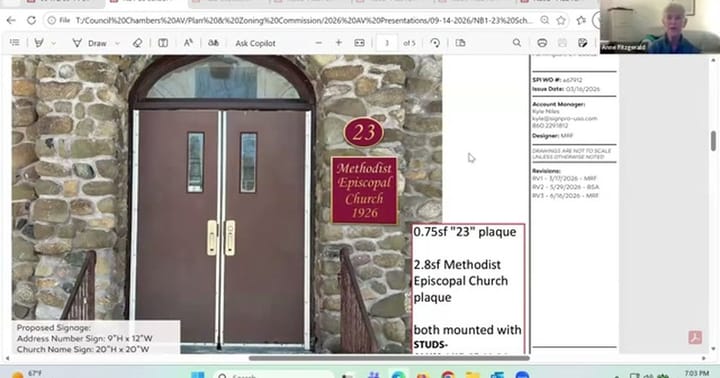
Background and stakes: The town-owned building at 23 School Street in Unionville, once the Methodist Episcopal Church and more recently a youth annex, is marking what commissioners confirmed was the church's 100th anniversary this November. The Unionville Historic District approved a commemorative sign at its August meeting, and the town manager signed off on the application proceeding.
The question before the body: Whether to approve an attached building sign and historic plaques for the facade, presented by Anne Fitzgerald of the Town of Farmington.
Substantive content and deliberation: Commissioner Josh Davidson raised the only substantive objection, questioning whether labeling the active town-owned building "Methodist Episcopal Church" would confuse visitors into thinking it remains a working church. "I guess I'd like to see changes to the wording on the sign that it doesn't seem appropriate as it's wording," Davidson said, while stressing he had no objection to the historic recognition itself. Fitzgerald said the building is not in regular active use and will be reviewed by the town council for future purposes. Lisa Fagan asked how the sign would be anchored to the stone facade; staff confirmed it will be drilled through the stone rather than the mortar joints to avoid loosening. Rob Ingbertson confirmed plaque placement will flank the door, with national, state and local historic markers eventually grouped together.
Outcome: The commission voted unanimously to approve the sign and plaque installation.
Tunxis Mead Concession Stand Signage
Background and stakes: The Farmington Recreation Department refurbished a long-vacant concession stand at Tunxis Mead, now operated under lease by the Daily Grind coffee shop alongside the Farmington Soccer Club and the recreation department.
The question before the body: Whether to approve a building-mounted identification sign for the three users, presented by Jesse Cayetano of the Town of Farmington.
Substantive content and deliberation: Commissioner Bob Canto asked who was paying for the sign (the recreation department, not Daily Grind) and why the coffee shop's portion was sized larger than the two established users. Cayetano explained the business is newer and the town wanted to emphasize its presence. Canto pressed further on what happens if Daily Grind's annual lease is not renewed: "So is this something that like, if they decide not to renew their lease next year, are we going to be able to take that daily grind out of there and put somebody else in there? Or is it the whole sign going to have to be replaced?" Cayetano confirmed the whole sign panel would need replacing, though a vinyl overlay could potentially be applied in the future to reduce cost, a point Peter Zarella raised separately with the sign vendor.
Outcome: The commission voted unanimously to approve the sign.
First Application Under the State's New Middle-Housing Law
Background and stakes: Public Act 25-1, passed during the November 2025 special legislative session, allows developers to convert or build two-to-nine-unit housing on commercially zoned land through a streamlined "summary review" process, ahead of Farmington's own text amendment implementing the law later the same evening.
The question before the body: Whether to approve, by summary review and site plan only, Jeff Bernatich's application to convert his vacant former insurance office at 1422 Farmington Avenue into a two-family residential dwelling within a B-1 business zone.
Substantive content: Rutherford explained that the property had been residential, briefly used in part as a daycare, before the zone was changed to business use in 2014 to accommodate an All State office. Public Act 25-1 permits residential conversion in business zones "as of right" with site plan review, without requiring the zone itself to change from B-1. Bernatich said the building already has two kitchens and two separate entrances and requires minimal interior modification.
Deliberation: Commissioner Phil Cardero confirmed the application was "the first thing we've seen" under the new act. Josh Davidson said the property's location and layout made the conversion sensible: "It makes a lot of sense to it," he said, noting the site "looks like a house" despite its commercial zoning. Rob Ingbertson raised a parking-safety question about vehicles parked close to the building, prompting Rutherford to note a concrete curb and step already provide some protection, though not a formal regulatory barrier.
Outcome: The commission voted unanimously to approve the summary review application.
FEMA-Driven Flood Map and Subdivision Amendments
Background and stakes: Updated Federal Emergency Management Agency flood insurance studies and rate maps require Farmington to revise its Flood Protection Zone, Flood Perimeter Overlay Zone and subdivision regulations.
The question before the body: Whether to formally accept the two applications and schedule public hearings.
Outcome: The commission voted unanimously to accept both text-amendment applications, for Article 2 Sections 15 through 17 and for Subdivision Regulations Sections 1.2, 4.17 and 4.19, and scheduled public hearings for both for September 28, 2026, alongside a third flood-related matter already pending from July.
GG Mart Special Permit Hearing
Background and stakes: An application for a special permit and site plan approval for a grocery store, beer permit and gas station at 1387 Farmington Avenue in a B-1 zone had already been postponed once before Monday's meeting.
The question before the body: Whether to continue the hearing again.
Deliberation: Liz Sanford confirmed with staff that the applicant and their attorney were aware of and had agreed to the further delay. Commissioner Peter Zarella questioned whether an aerial photograph submitted in place of an updated site plan satisfied Article 4, Section 12's requirement that special permits include a site plan, since no physical site changes are proposed; staff agreed to look for a formal site plan on file.
Outcome: The commission voted unanimously to continue the hearing to September 28, 2026.
Special Permit for Bungalow Hill Road Addition
Background and stakes: Applicant Michael LaPierre sought a special permit because his proposed addition would push his home at 3 Bungalow Hill Road past the 1,600-square-foot living-area threshold in the R-9 OG zone.
The question before the body: Whether to approve a special permit and site plan for a two-story, 14-by-32-foot rear addition containing roughly 903 square feet of new living space.
Substantive content: LaPierre said the addition, a walkout basement counted as a full floor because it is fully exposed and heated, would add a bedroom, bathroom, sitting area and stairway, originally conceived to accommodate a father-in-law with vision loss and limited mobility. The existing ranch is approximately 970 square feet. Commissioner Lisa Fagan sought clarification on the total resulting square footage; staff confirmed the open basement area was already counted toward the 1,600-square-foot limit.
Deliberation and outcome: A neighbor at 18 Oakland Avenue, identified in the hearing only as "Wen Young" ("when Leanne" in the ASR transcript, confirmed via Zoom as a downhill abutter), raised privacy concerns about the two-story addition but withdrew the objection once staff clarified the expansion faces the rear of the lot, away from her property. No written comments were received. The commission voted unanimously to approve the special permit and site plan.
Sign Regulations Rewrite Continued Amid Wording Disputes
Background and stakes: Assistant Town Planner Garrett presented a comprehensive rewrite of Article 4, Section 7 (Signs), prompted partly by the U.S. Supreme Court's Reed v. Town of Gilbert decision, which bars sign regulations that require reading a sign's content to determine which rule applies.
The question before the body: Whether to close the public hearing and adopt the revised sign regulations.
Substantive content: The rewrite reorganizes exemptions for flags, interior and "open" business signs (capped at two square feet if illuminated, 12 square feet if not), charitable and philanthropic signs in residential zones, attached and detached commercial signage tied to building frontage, temporary signs for charitable fundraising events, contractor signs, halo-lit illumination standards (limited to 4,000 Kelvin or less, and to multifamily developments of at least 50 units outside Unionville Center and Farmington Center), and a new standalone section for directional signage on multi-building sites.
Deliberation: Commissioner Peter Zarella questioned whether "professional" organizations should be eligible for the flag-sign exemption, worried it could be read to allow corporate logo flags. The commission tentatively favored narrowing the language to "non-commercial" institutions, pending review by the town attorney, identified in the discussion as Bob DeCrescenzo. A longer debate centered on the word "semi-public" in the section governing temporary signs for charitable and fundraising events. Commissioner Phil Cardero argued organizations like the Farmington Land Trust are legally private corporations, not "semi-public," and that the term should be struck or clarified; Commissioner Peter Zarella and Rutherford countered that removing it could unintentionally exclude quasi-governmental or mixed-funding groups the commission intends to cover. Garrett noted enforcement in practice relies on staff discretion regardless of the precise wording.
"We're not debating whether it's a corporation, a non-profit or whatever. We're not debating whether it's a corporation, a non-profit or whatever," Cardero said, arguing the commission should focus on an organization's charitable purpose rather than its corporate structure.
Procedural outcome: Rather than close the hearing, the commission voted to continue it to September 28, 2026, directing staff to consult the town attorney on the "semi-public" and flag-exemption language before returning.
Ground-Mounted Solar Regulation Debate and ZBA Pushback
Background and stakes: Farmington has no dedicated regulation for ground-mounted residential solar arrays; applications have been processed informally under the zoning code's satellite-dish antenna rules, with cases exceeding those yard requirements routed to the Zoning Board of Appeals for a variance before returning to Planning and Zoning for site plan approval. Staff said they have handled three or four such ZBA cases in recent years and sought a dedicated regulation.
The question before the body: Whether to adopt a new Article 4, Section 2G governing ground-mounted solar arrays for one-to-four-family homes, including when the commission itself, rather than the ZBA, may grant relief from standard yard setbacks through a special permit.
Substantive content: The proposed regulation requires documentation that a roof-mounted array is structurally infeasible or insufficient to meet "the approximate energy requirements for the property," limits arrays to 15 feet in height measured to the panel's peak, and generally confines placement to rear yards, with special-permit exceptions for corner lots and oversized lots (at least twice the zone's minimum lot area) in the R-80 and R-40 zones, where screening "may" be required if it does not reduce panel efficiency.
Deliberation: Commissioner Josh Davidson pushed to tighten the standard, suggesting the regulation specify "annual" energy requirements and proposing that an applicant whose roof could generate more than roughly 75 percent of household usage should not qualify for a ground-mounted special permit at all: "I don't think that it's an economic decision because I think the economics on this change every year," he said, arguing the commission's real concern is aesthetic and environmental impact, not payback period, and that screening requirements should not be waived whenever they reduce panel efficiency. Commissioner Peter Zarella argued for shifting all ground-mounted solar review to a mandatory special permit, rather than site plan approval in compliant cases, to preserve commission discretion, and asked staff to survey solar vendors on the "tipping point" at which roof-mounted installation stops making financial sense. Commissioner Phil Cardero asked Assistant Town Planner Kara to explain the preference for roof-mounted systems; she cited the town's lack of a hard impervious-coverage limit in residential zones and the goal of limiting new impervious surface and stormwater runoff from ground arrays.
Two members of the Zoning Board of Appeals addressed the commission during public comment. Alternate Commissioner Haritha Subramanian said the ZBA, which has met only twice in the past year, has developed specific expertise reviewing solar variances and was not consulted on the proposed jurisdictional shift. ZBA Chair John Schoenhorn submitted a written objection and spoke by phone, saying he supports creating clear standards but objects specifically to Sections 3 and 4 of the draft, which govern special-permit exceptions and discretionary screening. He noted the ZBA handles roughly two ground-mounted solar cases a year, typically in under an hour, and that one recent case drew 12 to 15 public speakers. "I think it's unwise to have the caveat that screening is only, could only be required, uh, if it doesn't cut back on, on, uh, energy production," Schoenhorn said, arguing the rule as drafted would let reflective, highly visible arrays go unscreened whenever screening reduced output. Rutherford and Garrett responded that the regulation does not strip the ZBA of all authority. Setback, street-line and height requirements in subsections 2D through 2F would still require a ZBA variance; only the corner-lot and oversized-lot rear-yard flexibility in 2A through 2C would move to a Planning and Zoning special permit.
Procedural outcome: The commission voted unanimously to continue the public hearing to September 28, 2026, without resolving the jurisdictional question or the specific percentage threshold Davidson proposed.
Commission Adopts State-Mandated Middle Housing and Floor-Area Rules
Background and stakes: Public Act 25-1 of the November 2025 special legislative session requires municipalities to permit "transit community middle housing developments" of two to nine units, and mixed-use developments combining residential and commercial uses, on any land zoned commercial or mixed use, through "summary review" rather than a public hearing or special permit. Separately, a 2021 law, Public Act 21-29, bars towns from imposing minimum floor-area requirements beyond what state building codes require.
The question before the body: Whether to adopt a town-wide zoning text amendment implementing both laws, plus unrelated administrative cleanups, across nearly every article of Farmington's zoning regulations.
Substantive content: Garrett presented the amendment in reverse order, starting with housekeeping items: repealing an expired 2023 multifamily housing moratorium and an expired 2013-14 medical marijuana production moratorium, correcting the town's zone list to include previously omitted affordable-housing and mixed-development floating zones, and removing stray references to billiard parlors and mixed-use provisions specific to Unionville Center that became obsolete when that zone was formally adopted. The Public Act 21-29 changes strike minimum floor-area and minimum-bedroom-count language from the senior/active adult housing zones, cluster development standards, the R-9 multifamily cluster zone, Unionville Center, the affordable housing zones, Farmington Center, the Special Innovation floating zone and the Midpoint Development District, replacing a deleted article-wide minimum floor area section with a placeholder marked "reserved."
For Public Act 25-1, the amendment adds "transit community middle housing development" and "mixed use development" as permitted uses, subject to summary review and site plan approval, in the professional office, business-restricted, business, industrial and industrial-restricted zones, Unionville Center and Farmington Center. New Article 4, Section 31 sets development standards for these projects: density capped at eight units per net acre unless the underlying zone states otherwise; mandatory Architectural Design Review Committee referral; building materials restricted largely to brick, stone, lap siding, board-and-batten or shingles, with glass barred from constituting a majority of any facade; roofs required to overhang walls by at least six inches; and, for mixed-use buildings, a requirement that commercial space occupy at least 60 percent of the first floor and that no residential units occupy the first floor in projects of more than 10 units. The amendment strips minimum off-street parking requirements for residential developments of 16 units or fewer and caps requirements at one space per studio or one-bedroom unit and two spaces per unit with two or more bedrooms for larger projects, unless a developer submits a parking-needs assessment the commission approves.
Deliberation: Garrett estimated the new provisions affect roughly 11 percent of Farmington's land area combined across the affected zones, much of it concentrated along Route 4, New Britain Avenue and Scott Swamp Road, and noted a significant share of the industrial-restricted zone is undevelopable open space owned by the state. Commissioner Phil Cardero asked whether the changes stemmed from a documented effort to deter housing through minimum-size requirements; Garrett said that was his understanding of the legislative intent, while noting the change could also encourage smaller, more attainable units. Commissioner Josh Davidson asked whether a mixed-use development's commercial space, once approved, could later be swapped for a more intensive use like a nightclub without further review; Garrett and Rutherford said changes in use category would require commission approval under the amendment's anti-"bait and switch" language, while routine tenant turnover within an approved category would not.
Procedural outcome: After extensive staff presentation and limited commissioner questions, with no members of the public remaining to comment and no written correspondence received, the commission closed the public hearing and voted unanimously to approve the zoning text amendment implementing Public Act 25-1, Public Act 21-29 and the accompanying administrative edits.
Implications: The vote takes effect immediately; Garrett noted an applicant cannot argue the prior regulation still applies simply because the amendment was pending. Staff said they expect only one or two transit community middle housing or mixed-use applications per year given the limited inventory of eligible small commercial parcels, citing Bernatich's application earlier in the meeting as a likely model case.
Other Administrative Matters
Staff walked through several routine agenda-review items, including a retail space reconfiguration near a former pharmacy site, without objection from commissioners. Rutherford reported the town's Plan of Conservation and Development update is advancing toward an October 5 community survey launch, with an oversight committee meeting scheduled the following Monday and a consultant presentation from Weston and Sampson planned for the commission's October 5 meeting. The commission closed the meeting by voting unanimously to approve the minutes of its July 27, 2026 meeting.
WHO WAS THERE
Liz Sanford, Chair, present. Bob Canto, member, present. Phil Cardero, member, present. Josh Davidson, member, present. Peter Zarella, member, present. David St. Germain, member, present. Lisa Fagan, alternate, present. Rob Ingbertson, alternate, present. Taylor Pogson, alternate, absent. Shannon Rutherford, Town Planner, present, staff. Garrett, Assistant Town Planner (surname not given in available sources), present, staff. Kara, staff member who addressed stormwater and impervious-coverage standards for solar (surname and title not given in available sources), present.
Public commenters and applicants: Anne Fitzgerald, Town of Farmington, presenter for 23 School Street sign application. Jesse Cayetano, Town of Farmington (Recreation Department), presenter for Tunxis Mead concession stand sign. Jeff Bernatich, applicant, 1422 Farmington Avenue conversion. Michael LaPierre, applicant, 3 Bungalow Hill Road special permit. A neighbor at 18 Oakland Avenue, identified by first name only as "Wen" or "Wen Young" in the hearing (ASR rendering uncertain), spoke by phone regarding privacy concerns on the LaPierre application. Haritha Subramanian, alternate commissioner, Zoning Board of Appeals, public comment opposing ground-mounted solar jurisdiction shift. John Schoenhorn, Chair, Zoning Board of Appeals, resident of 155 Town Farm Road, public comment and written objection opposing ground-mounted solar jurisdiction shift. A written comment was also received from a resident of Brickyard Road regarding the solar regulation, identified in the transcript as "Mr. Bogson" (spelling uncertain; may be a mis-transcription of "Pogson").
ORGANIZATIONS AND DOCUMENTS REFERENCED
Public Act 25-1 (November 2025 special session) — state law requiring municipalities to allow summary review of two-to-nine-unit "transit community middle housing developments" and mixed-use developments on commercially zoned land; central subject of the evening's final public hearing and vote. Public Act 21-29 — 2021 state law barring municipal minimum floor-area requirements for dwelling units beyond state building/housing code standards; implemented through the same amendment. Reed v. Town of Gilbert — U.S. Supreme Court decision cited by staff as the basis for restructuring sign regulations to avoid content-based rules that require "reading" a sign to determine applicable standards. Federal Emergency Management Agency (FEMA) — cited as the basis for pending Flood Protection Zone and subdivision regulation amendments and updated flood insurance rate maps, both scheduled for a September 28 hearing. Farmington Zoning Board of Appeals — board whose chair and an alternate commissioner testified in opposition to shifting ground-mounted solar siting authority to Planning and Zoning via special permit. Architectural Design Review Committee (ADRC) — advisory town committee that will review new construction and substantial renovations proposed under the transit community middle housing and mixed-use provisions. Farmington Land Trust — cited by commissioners as an example organization in the debate over whether "semi-public" accurately describes charitable groups eligible for temporary sign permits. Weston and Sampson — consultant scheduled to present on the town's Plan of Conservation and Development update at the commission's October 5 meeting. Town attorney Bob DeCrescenzo — referenced throughout as the source the commission will consult on final wording for the flag-sign "professional" exemption and the "semi-public" temporary-sign language before the September 28 continuation.
Share this story
Know someone in Farmington who follows town government? Share Townbrief Farmington: they can sign up free.