Farmington Approves Stone Display, Delays Sign Vote
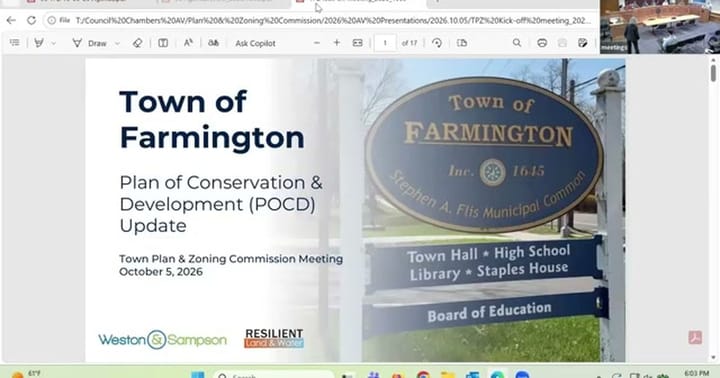
Farmington's Town Plan and Zoning Commission kicked off a yearlong update to its Plan of Conservation and Development and heard details on a companion community survey launching October 9.
Planning and Zoning · Meeting of October 5, 2026
Farmington's Town Plan and Zoning Commission kicked off a yearlong update to its Plan of Conservation and Development and heard details on a companion community survey launching October 9. Weston and Sampson project manager Robert Collins and Resilient Land and Water principal David Murphy outlined a three-phase process aimed at adoption by fall 2027, including three public open houses starting December 1. Commissioners approved, without opposition, an outdoor stone-carving display application from Michael Angelicola at 346 Scott Swamp Road.
The commission continued two pending zoning text amendments, covering business signage and ground-mounted solar arrays, to October 26 after extended debate; member Josh Davidson said unclear rules leave businesses with "cluttered" A-frame signs, while Rob Ingbertson said ground-mounted solar arrays "are ugly no matter where they are."
In the full story:
- Who Was There
- Organizations And Documents Referenced
- The complete report — 2,722 words
Source: the Planning and Zoning meeting of October 5, 2026, reported from the official video recording and transcript.
Checked against the record: before publication this article was automatically compared with the meeting transcript.
The Full Article
Plan of Conservation and Development Kickoff and Community Survey
Background and stakes: Connecticut law requires municipalities to update their Plan of Conservation and Development (POCD) roughly every ten years. Farmington's current plan dates to 2007-08 with a 2018 addendum, and the update is now being paired with a parallel revision of the town's strategic plan, with both efforts sharing a single community survey launching this week.
The question before the body: Commissioners were asked to hear an introductory presentation on the update process, schedule and community-engagement plan, with no vote required at this stage.
Substantive content: Robert Collins, senior project manager at Weston and Sampson, said the firm's team includes principal-in-charge Jim Reardon; AICP planner Stephanie Camp, formerly Stratford's town planner and a leader at the South Central Connecticut regional council of governments; community-engagement specialist Joanna Nadal; housing policy specialist Ashley Sweet; historic preservation planner Erin Mahard; and economic-development planner Karen Prescott. David Murphy, principal at Resilient Land and Water, will lead natural-resources, resiliency and climate-change content.
Collins described a three-phase process: information-gathering and a "community profile" (phase one, underway now); plan development including a community vision statement and chapter structure (phase two); and public review, a required 65-day state and regional comment period, adoption hearings and an implementation matrix (phase three). He said the team is targeting "substantial completion" by late June or early July 2027, with the 65-day review running over the summer and adoption hearings in September, aiming to meet a November 2027 deadline.
The community profile, Collins said, will exceed 100 slides and cover demographics, housing and affordability, economic data, land use, community facilities, infrastructure and a new state-mandated resiliency and sustainability section. Early data show Farmington's population has grown slightly over ten years, its foreign-born population is rising, average household size is shrinking toward 2.4 people, home values have risen nearly $100,000 in ten years, and the share of residents below 80 percent of area median income — a benchmark tied to workforce occupations such as teachers, police and firefighters — has declined, which Collins said "might also be a clue as to with the affordability factor going up that folks that are at a modest or a lower income might be being priced out of the community."
The Community Survey, combined with the town's strategic-plan update, was finalized by an oversight committee with two Town Plan and Zoning Commission (TPZ) members, two Town Council members and two Board of Education representatives. It carries 30 substantive questions plus ten demographic questions, is available in English, Mandarin, Spanish and Tamil based on the languages the Board of Education identified, and will launch October 9 with a target minimum of 400 statistically significant responses — though Collins said the town's outreach effort, including roughly 30 community events through early November, could generate "well over probably several thousand responses." Two questions, numbers 4 and 14, are mandatory; the rest are optional, and respondents may add an email address to receive updates without their response being shared publicly.
The deliberation: Commissioner Phil Cordero, who served on the consultant-selection and oversight committees, said the plan "remains... still excellent work" and noted the commission may help staff tables at survey events. Josh Davidson asked how to make the plan relevant to residents who have no direct memory of the prior POCD; Collins said open houses and the survey itself are designed to build that connection. Peter Zarella asked how the update will interact with Connecticut's new housing-production law and the regional housing growth plan. Collins said the data-first approach used in 22 prior affordable-housing plans he has worked on typically reveals housing needs residents do not expect, and that "it should be very unique to the needs of the town." Rob Ingbertson asked about advertising the survey to residents; Shannon, a planning staff member, said the town mailed a newsletter explaining the project and will deploy yard signs with QR codes once the SurveyMonkey link is finalized October 9.
Procedural steps and outcome: No vote was taken. Staff said the commission will be asked at its next meeting to approve a 2027 meeting calendar that includes a monthly placeholder POCD workshop on the fourth Wednesday of most months, plus an added December session to review the completed community profile.
Implications and what is next: The survey closes no earlier than mid-November; a summary report returns to the commission and Town Council before the first public open house, set for December 1 from 5 to 8 p.m.
New Business: Outdoor Display at 346 Scott Swamp Road
Background and stakes: Michael Angelicola, who recently relocated his stone-carving monument business to a property next to Cumberland Farms on Route 6, sought approval for an outdoor product display, a use requiring commission sign-off because the parcel spans three zoning districts.
The question before the body: Whether to approve an outdoor display and sales area for roughly 20 gravestones in the property's front and side yards.
Substantive content: The property splits across B1 (where Cumberland Farms sits), R12 and R40 zones, with the rear mostly wetland behind a steep embankment. Angelicola proposed displaying stones roughly 18 inches to three feet tall in a single-file arrangement between the building's two front doors and along a cleared hedge area, replacing a lawn sign with a reinstalled business sign on the original post, matching the size of a prior tenant's sign visible in Google Street View.
The deliberation: Members Phil Cordero, Josh Davidson, Peter Zarella, David St. Germain and Rob Ingbertson asked about signage history on the building, display density, lighting and setback from the road, which staff estimated at nearly 90 feet. Davidson raised concern the display could look "cluttered or haphazard," while Angelicola said his wife, Stephanie, who will run the office, would manage spacing so stones are not "too crowded." Ingbertson, appointed a voting member for the item, asked about stone dimensions and confirmed no lighting was planned for the sign.
Procedural steps and outcome: A commissioner moved "to approve the application made by Michael A. Angelicola, Stone Carving, for an outdoor display in sales at 346 Scott Swamp Road in a B1, R12 and R40 zone." The motion was seconded and passed with no recorded opposition or abstentions.
Implications and what is next: The business may install the display and replacement sign as presented; no further commission review is required unless the layout changes materially.
Continued Public Hearing: Sign Regulation Amendments
Background and stakes: The commission has been rewriting its sign regulations since opening a public hearing at its September 14 meeting, prompted largely by commissioner questions about vague or outdated language.
The question before the body: Whether to finalize text changes to government-flag, "open"/temporary sign, and for-sale sign provisions, or continue the hearing for further drafting.
Substantive content: Garrett, a planning staff member, presented sections highlighted since September 14, including adding "professional organization" (commissioners preferred "organization" over "association" by informal poll) to the list of flags exempt from sign rules, plus a bar on flags serving "commercial or advertising purposes"; replacing "when a business is open" with "indicating a business is open" for consistency across illuminated and non-illuminated signs; and a residential for-sale sign standard of six square feet for properties with 16 units or fewer and up to 32 square feet for larger properties, drawn from a pending state house bill.
The most contested item was the definition of groups allowed to post temporary event signs. Staff presented dictionary definitions of "semi-public" after commissioners questioned the term at the prior meeting, and ultimately the commission converged on allowing signs "advertising a non-commercial, charitable, social, educational, governmental, or fundraising event," dropping "public" and "semi-public" after members, including Dave St. Germain and Peter Zarella, said the terms added little protection.
The deliberation centered on undefined "open" and A-frame signs businesses display outside their storefronts. Staff explained the current rule, read literally, has permitted A-frame signs since a prior zoning official, Bill Warner, concluded roughly a decade ago that the regulation's plain text did not prohibit them, reversing an earlier practice of allowing only small flag-style "open" signs. Garrett said staff had consulted attorney Bob DiCrescenzo on whether sign content could be restricted, and was told directional and "open" signs could be limited to a business name without violating First Amendment content-neutrality rules, but that the town cannot selectively allow some businesses to advertise pricing while barring others. Davidson argued the gap has let some businesses display donated branded signage (from Pepsi or Sam Adams, for example) and others advertise lottery numbers or specific product prices, creating what he called visual clutter inconsistent with the town's detailed standards for permanent signs. "I guess I want to understand what our intent is here and basically almost pull this back to what do we think is appropriate for businesses to put out in terms of portable signage," Davidson said. He proposed a draft standard: one portable sign per business, no more than 12 square feet and four feet tall, placed no closer than 15 feet from the roadway or sidewalk, identifying only the business name and that it is open, with no pricing, contact information, lighting or balloons, displayed only during business hours. Rob Ingbertson said he worried added restrictions would burden small businesses that receive signs as free donations from vendors; Phil Cordero and David St. Germain said they had no strong preference either way. Staff said any new standard would require a phase-in period of roughly six months for existing non-conforming signs.
Procedural steps and outcome: No wording was finalized. Davidson agreed to email staff his draft restrictions so staff can compare them against regulations in Avon, Canton, Collinsville, Unionville-area practice and Glastonbury before the next session. A motion to continue the hearing to October 26 passed with no recorded opposition.
Implications and what is next: Business owners with existing A-frame or donated-branding signs face no immediate enforcement change; any new restriction would include a compliance grace period once adopted.
Continued Public Hearing: Ground-Mounted Solar Array Regulations
Background and stakes: Farmington has processed seven residential ground-mounted solar applications since 2017, four of which required Zoning Board of Appeals variances because they could not meet the town's existing satellite-dish-based siting standard. The commission is drafting a dedicated solar regulation to replace that workaround.
The question before the body: What standard should govern when a homeowner may install a ground-mounted array instead of, or in addition to, a roof-mounted system, and what dimensional limits should apply.
Substantive content: The draft under review stated a preference for roof-mounted arrays and required applicants seeking a ground-mounted array to demonstrate either structural roof inadequacy or that a roof system would not generate sufficient energy. New language discussed Monday would require stormwater management to prevent concentrated runoff onto neighboring lots, require non-functioning arrays to be removed within six months, and allow like-for-like panel replacement without new approval. Staff reported research showing solar companies generally see customers switch from roof to ground mounting when roof-based systems fall below 50 to 70 percent of a home's average five-year energy demand — the same demand figure Eversource uses to size its net-metering interconnections, which are capped at 25 kilowatts or a home's historic load. Comparison regulations from West Hartford (15-foot height limit, permitted only in R20-and-larger zones), Canton (full screening from adjoining lots and streets) and Norfolk and Southington (underground wiring, 500-square-foot face limits) were presented as models.
The deliberation turned on whether to set a numeric energy threshold or send atypical cases to the Zoning Board of Appeals under a hardship test, as the town has done informally for years. Phil Cordero asked directly "why are we pushing roof-mounted over ground-mounted" rather than letting homeowners choose; Josh Davidson said ground arrays are "kind of hulking technology structures that just don't feel like a residential neighborhood" and argued for larger setbacks and mandatory screening regardless of which standard prevailed. Rob Ingbertson said he had no preference between the two options on functional grounds, calling both "ugly no matter where they are," but supported requiring some numeric threshold "to create some sort of benchmark." Peter Zarella argued for shifting the whole provision to a special-permit process that would let the commission weigh aesthetics, neighbor impact and available alternatives case by case rather than committing to a fixed percentage, saying "there are many uses that require special permits, but only the general special permit factors sort of laid out in our regs," and volunteered to draft that alternative language. Staff cautioned that without a defined threshold, any denial risks being called arbitrary if challenged.
Procedural steps and outcome: No standard was adopted. Zarella agreed to draft special-permit-based language for comparison against the percentage-based draft; staff will prepare a side-by-side version. A motion to continue the hearing to October 26 passed with no recorded opposition.
Implications and what is next: Homeowners with pending or contemplated ground-mounted solar projects continue to face case-by-case variance review at the Zoning Board of Appeals until the commission adopts a standard, expected no earlier than late October.
Planner's Report and Administrative Items
A proposed accessory dwelling unit application at 19 Perry Street was continued from the Architectural Design Review Committee's October 15 meeting to November or December at the applicant's request to refine drawings. Staff said the 2027 TPZ meeting calendar, including the added monthly POCD workshop, will come up for approval at the commission's next meeting, alongside October 6 meeting minutes still being finalized. The meeting adjourned at 9:50 p.m.
WHO WAS THERE
Liz Sanford — chair, as confirmed by meeting address ("Madam Chair") and her self-identification as the only woman present; role not confirmed by any roster for this exact date. Phil Cordero — member, present. Josh Davidson — member, present. David St. Germain — member, present (referred to as "Dave" in discussion). Peter Zarella — member, present. Rob Ingbertson — member, present; appointed a voting member for the Angelicola application. Bob Canto — member, absent. Lisa Fagan — member, absent. Taylor Pogson — member, absent. Shannon — planning staff member; title not stated in the transcript. Garrett — planning staff member; title not stated in the transcript; presented sign and solar regulation drafts. Bruce — referenced by staff as having institutional history on sign enforcement; not confirmed present. Robert Collins — senior project manager, Weston and Sampson; presented the POCD update. David Murphy — principal, Resilient Land and Water; presented alongside Collins. Michael Angelicola — applicant, owner of Stone Carving (monument business), 346 Scott Swamp Road.
ORGANIZATIONS AND DOCUMENTS REFERENCED
Weston and Sampson — planning consultant leading the POCD update, including Robert Collins, Jim Reardon, Stephanie Camp, Joanna Nadal, Ashley Sweet, Erin Mahard and Karen Prescott. Resilient Land and Water — subconsultant led by David Murphy, focused on natural resources, resiliency and climate content for the POCD. South Central Connecticut regional council of governments — Stephanie Camp's prior employer, cited for her regional planning background. Capitol Region Council of Governments (referred to as "Krog" in the meeting) — regional body that will review the draft POCD during the required 65-day state review period. Town Council and Board of Education — co-participants, via an oversight committee, in drafting the combined Community Survey and strategic plan. American Planning Association / AICP — national certification body referenced when explaining staff planners' credentials. SurveyMonkey — platform hosting the Community Survey, discussed for its response-randomization and partial-response handling features. Eversource — electric utility whose net-metering interconnection limits (25 kilowatts or historic home load) were cited as a benchmark for the proposed solar-array energy threshold. Connecticut Department of Energy and Environmental Protection — cited for stormwater-management guidance applied informally to solar array drainage. West Hartford, Canton, Norfolk, Southington, Glastonbury — comparison municipalities whose sign or solar ordinances staff cited during both hearings. Plan of Conservation and Development (2007-08, with 2018 addendum) — the existing plan being updated; its retained chapters on natural resources were cited as a model. Pending state housing law and regional housing growth plan — cited by commissioner Peter Zarella and Robert Collins as context the POCD must align with. State house bill on residential for-sale signage — cited as the basis for the proposed 16-unit/32-square-foot sign threshold. Town satellite-dish regulation — the existing zoning standard currently used, by analogy, to review ground-mounted solar arrays pending adoption of a dedicated regulation.
Share this story
Know someone in Farmington who follows town government? Share Townbrief Farmington: they can sign up free.