Farmington Panel Finalizes Community Survey Draft
Farmington's survey oversight committee finalized nearly all remaining questions for a combined Plan of Conservation and Development and strategic-plan survey, targeting an October 9 launch.
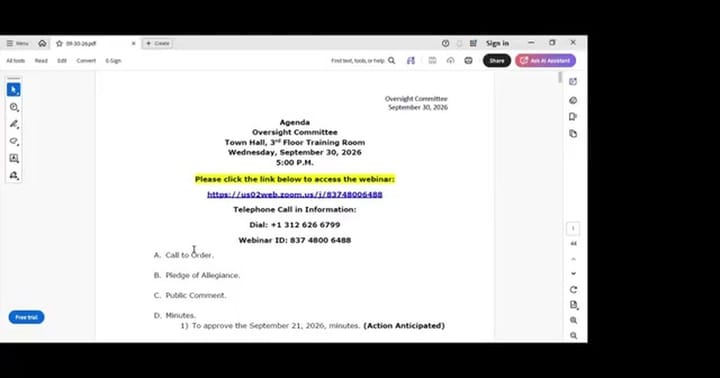
Other Committee · Meeting of September 30, 2026
Farmington's survey oversight committee finalized nearly all remaining questions for a combined Plan of Conservation and Development and strategic-plan survey, targeting an October 9 launch. The panel voted to split tax and facility questions between town and school categories, add items on a potential new elementary school and expanded preschool services, and let respondents pick up to six community priorities instead of four. Staff member Kat said outreach will use roughly 29 volunteer slots at town events starting October 17, including fire department breakfasts, early voting at Town Hall and Election Day polling locations.
One member noted the town is "intending to have a referendum" tied to public safety facilities, though no date or scope was given. The September 21 minutes were approved with one abstention, and the finished survey will run 29 substantive questions plus 12 demographic items, with completion time now pegged at 20 to 30 minutes.
In the full story:
- Who Was There
- Organizations And Documents Referenced
- The complete report — 3,542 words
Source: the Other Committee meeting of September 30, 2026, reported from the official video recording and transcript.
Checked against the record: before publication this article was automatically compared with the meeting transcript.
The Full Article
Public Comment: Survey Matrix Formatting
Background and stakes: Farmington's combined community survey, meant to feed both the town's Plan of Conservation and Development update and its strategic plan, had already drawn committee attention to how a historic-and-cultural-resources question would be formatted. Jay Tulin, identified in the meeting as a Timberline Drive resident, used public comment to press for clarity on that design choice before the committee moved to its main business.
The question before the body: Whether respondents to question 12 would rate each listed cultural or historic resource individually or select only a subset.
Substantive content: Tulin noted the question lists options including community events and festivals, local arts and cultural organizations, and cultural programs for youth and families, and asked whether the survey would use a matrix for all items or let respondents pick a few. Staff member Shannon Rutherford answered that the question will appear as a chart in which every listed item gets its own row, and respondents choose, via dropdown, whether the town offers "too much," "too little," or they "don't know," for each item separately.
"Each item will be listed, and then for each item, the respondent will be able to say too much, too little, or don't know." [00:02:23] — Shannon Rutherford
Procedural steps and outcome: No vote was required; this was an informational exchange during public comment, and the committee moved directly to approving its September 21 minutes, which passed with one abstention and no recorded opposition.
Implications and what is next: The matrix format Rutherford described will apply broadly across the survey's rating-style questions, a design choice the committee returned to repeatedly later in the meeting when deciding whether to combine or separate other rating questions.
Part One: Land Use, Business and Neighborhood Map Revisions
Background and stakes: At a prior meeting the committee had flagged several draft questions in Part One for revision, including whether to combine separate questions about Farmington and Unionville and whether to keep a question asking if Farmington is a good place to do business.
The question before the body: Whether to formally adopt Part One of the draft survey with the previously discussed edits.
Substantive content: The committee recommended removing the "is Farmington a good place to do business" question, reasoning that most residents, as opposed to business owners, would not have a basis to answer. After consulting with the outside survey consultant, the committee also decided not to merge the Farmington and Unionville questions onto a single matrix, citing platform limitations inside SurveyMonkey. Wording for a transportation question was revised from bare references to "traffic" and "pedestrian safety" to full statements: "traffic congestion is a problem" and "it is safe for pedestrians." A land-use question that duplicated material covered in the facilities section (old question 14) was removed. The committee also finalized a new 11-by-17 neighborhood reference map, derived from a 2006 Town Plan and Zoning map, that strips individual parcels but keeps state routes and key arterials such as Meadow Road, Burlington, New Britain Avenue, Copper Mine and Red Oak labeled.
The deliberation: Members debated whether to add a flood-plain designation to the map given there are no homes in that zone; staff said the flood-plain area was retained "for consistency" with the 2006 map and because it remains a distinct area discussed in the POCD. A separate discussion addressed whether to split cultural and inclusion programming questions by age group after one member raised concern that youth respondents' interests in community events differ from adults'. The group ultimately agreed to create two line items — "cultural and inclusion programs for youth" and "cultural and inclusion programs for adults" — rather than add an entirely new question.
Procedural steps and outcome: The committee passed a motion to temporarily approve ("TA") the youth/adult cultural-programming split, then passed a broader motion approving all of Part One as amended. Both votes carried without recorded opposition.
Implications and what is next: Part One's substance is now locked pending final staff formatting; the committee later voted (see below) to move Part One behind Part Two in the finished survey's question order.
Part Two: Quality of Life, Municipal Services and Facilities
Background and stakes: Part Two covers broader "quality of life" and municipal-services questions modeled partly on two previous town surveys, giving the committee a basis for comparison over time, according to members.
The question before the body: Whether to adopt, item by item, each draft question in Part Two, including character limits, rating scales, and which municipal services to list separately.
Substantive content: For an open-ended question on what residents value about Farmington (question 1), the committee set a 500-character limit after discussing complaints that unlimited text fields can unexpectedly cut users off mid-sentence; members agreed to apply the same 500-character cap to all open-text questions, including a question on how residents' experience in Farmington has changed over 10 years.
Question 4, asking residents to pick their top four challenges facing Farmington from a list including transportation and pedestrian issues, school facility needs, economic development, land use and "lack of housing options and affordability," was approved after the committee agreed to drop "Town of" from the question for consistency with other questions' phrasing.
Questions 5 and 6, both asking residents to rate town government and the Farmington Public Schools, were combined into a single matrix question rating "the following Farmington government services" side by side, a change proposed in part to reduce the survey's overall question count. Question 7, asking whether residents feel they receive fair value for their property taxes, was restructured as a small matrix separately rating town government and public schools rather than a single combined question, preserving a distinction one member said mattered "because the survey 10 years ago was very heavy on that type of topic."
Question 8, rating municipal services, was expanded after a member argued that lumping all Public Works Department functions together obscures differences in how residents feel about specific services: "they may hate how the roads are done, but they're very happy with the trash pickup." The committee agreed to list roadway maintenance, snow clearing and park maintenance under Public Works, and to add separate line items for the wastewater treatment plant, labeled with "(sewer)" in parentheses, and for trash pickup, since residents receive distinct bills for those two services.
Question 9, rating the condition of actively used public buildings, generated discussion over whether to relabel the Farmington Public Schools Central Office as the "former 900 wing," paralleling the Town Hall's "former 1928 building" label, to help residents who don't know what the Central Office is. Members also debated the educational value of asking residents to rate buildings, such as fire stations, that the public rarely visits, with one member cautioning that strong public ratings of fire station buildings likely reflect goodwill toward the fire department rather than knowledge of facility conditions: "if this comes up very high that the buildings are in good shape when we know they're not, that tells our building committee we really have a marketing issue."
Question 10, on underutilized buildings such as the Unionville Annex, Youth Center, Old Firehouse, Stonehouse, and Town Hall Annex, prompted a discussion about whether to disclose that reuse ideas carry renovation costs. A member referenced a prior budget-season estimate of roughly $7 million to convert space in the Town Hall Annex, and the committee agreed to revise the question's framing to note that underutilized buildings "need various states of renovation."
Question 11, rating public recreation and open-space facilities, was expanded with named examples — including Alsop Meadow/Clover Penny Park, the Unionville Gazebo, Suburban Park, Tunxis Mead Park, Westwoods Golf Course, Westwoods Recreation Complex and Yakins Park — after members noted many residents don't know these facilities by name. The committee also added examples to an "open space properties throughout town" item, citing the Reservoir Road property, and added a new item for town-owned farmland, listing Pine, Krall and Sub-Edge farms, garden plots, and what residents commonly call "the Flats" along the Farmington River.
Questions 12 through 15 covered facilities and programs residents feel are lacking, recreation program volume ("too many," "about the right amount," "too few"), and frequency of use. During discussion of question 13's matrix of existing recreation programs and facilities, the committee voted to eliminate a redundant open-ended "other" sub-item because it duplicated question 14, which separately asks what facilities or programs residents feel are missing.
The deliberation: Several members pushed to keep the municipal-ratings questions closely comparable to the town's prior two surveys for benchmarking purposes, while others pressed for new breakouts — on public-works services, building conditions, and recreation facilities — to capture more specific resident feedback. The tension recurred across nearly every question: how much to expand options without lengthening the survey past a manageable size.
Procedural steps and outcome: Each question was adopted through a separate temporary-approval ("TA") motion; every vote identified in the transcript passed without recorded opposition, though abstentions were occasionally noted procedurally without a specific count given.
Implications and what is next: These service- and facility-rating questions form the bulk of the survey's municipal-services section and will generate department-by-department resident feedback that staff said will be cross-referenced against the broader government-approval question.
Visioning and Tax Priorities (Questions 16-17)
Background and stakes: The final two questions in Part Two ask residents to rank community priorities and gauge appetite for increased tax spending across specific categories, mirroring heavily weighted budget-related questions from a survey conducted roughly 10 years earlier.
The question before the body: How to structure priority-ranking and tax-tolerance questions without overwhelming respondents who reach the end of a long survey.
Substantive content: Question 16 originally asked residents to rank up to 17 community priorities from top to lowest; the committee replaced full ranking with a "select up to six" format after a member warned that forcing respondents to rank all 17 options risked fatigue: "people are going to get tired of ranking... 16, 14, 13." The committee split a combined "town and educational services" priority into separate town and school items.
Question 17 asks how high a priority it should be to increase tax dollars for specific services, explicitly flagging that answering "very high" implies higher taxes. The committee split the facilities item into separate town and school categories, added language on expanding "services and opportunities" for Farmington Public Schools students, added a public safety services item, and added a "more opportunities for regionalization" item, noting an earlier regional dispatch consolidation that one member said "actually made us money." Members also debated, and ultimately added, two new items: expanding preschool services and supporting construction of a new elementary school building, after one member pressed to gauge "what is the appetite" for expanded education infrastructure given ongoing preschool waitlists.
The deliberation: Members disagreed over question wording rather than substance. One member objected that phrasing referencing "increased spending" reads as presuming higher taxes are already decided: "to me, it sticks out like, all right, we're raising the taxes, whether you like it or not." Another member defended the framing, arguing it deliberately lets anti-tax respondents answer "not very high" across every item to register their preference clearly. A separate member raised, then dropped pursuing, an explicit question about per-pupil education spending, which another committee member said a previous commenter, referred to as "Mr. Kelly," had raised during an earlier session; the group opted instead for broader "expand services and opportunities" language rather than a dollars-per-student metric.
Procedural steps and outcome: The committee approved question 16 with the six-priority cap and town/school split, and separately approved question 17 with the public safety, regionalization, preschool and new-school additions. Both votes carried without recorded opposition. During the discussion, one member noted "we are intending to have a referendum" regarding public safety facilities, suggesting town plans for a ballot question on facility spending, though no further detail, date or project was specified in the meeting.
Implications and what is next: These two questions will most directly inform whether town officials pursue tax increases for school facility construction, preschool expansion, or public safety investment, and the brief reference to an intended referendum signals a related ballot item may be forthcoming, though its scope remains undefined in this meeting's record.
Survey Structure, Length and Section Reordering
Background and stakes: With the combined survey now totaling 29 substantive questions plus 12 demographic items, staff and committee members weighed whether the survey had grown too long and in what order sections should appear.
The question before the body: Whether to cut or reorder questions, and how to set resident expectations about how long the survey will take.
Substantive content: Staff said industry guidance typically recommends 25 to 28 questions for a survey of this kind, putting Farmington's combined instrument slightly over that range. Rather than cut content, the committee chose to revise completion-time messaging from "15 to 20 minutes" to "20 to 30 minutes." The committee then voted to reorder the survey so Part Two (quality of life, municipal and educational services, community facilities, and visioning/priority questions) runs first, followed by Part One's parks and recreation, transportation, economic development, housing, natural resources and historic/cultural resources sections, with demographic "about you" questions remaining last.
The deliberation: One member argued for keeping the visioning and priority questions near the end, saying they flow naturally after facility- and service-rating questions; another countered that placing the highest-value priority questions (16 and 17) too close to the end risks respondent drop-off, since "these last questions are the ones" the committee most needs answered. The reordering motion represented a compromise: moving the previously labeled Part Two to the front in its entirety rather than relocating individual questions.
Procedural steps and outcome: The committee passed a motion to swap Part One and Part Two's order; the vote carried, with one abstention noted procedurally but no specific count given in the record.
Implications and what is next: The finished survey will now open with quality-of-life, municipal-services and visioning questions before moving into topic-specific sections, a structural decision staff said should reduce the risk that the most policy-critical questions get skipped due to survey fatigue.
Marketing and Outreach Plan
Background and stakes: With the survey nearing completion, the town's staff presented a marketing plan to drive response rates, an effort the committee has flagged as essential given the combined survey's length and importance to both the POCD and strategic plan processes.
The question before the body: Whether the proposed outreach plan, timeline and volunteer structure were sufficient ahead of a target launch.
Substantive content: Staff member Kat told the committee that town staff have identified more than 25 community events beginning October 17 where volunteers can hand out postcards with a QR code linking to the survey, including Tunxis Mead events, Daily Grind coffee shop, a senior center "care fair," two Farmington High School football games, a fire department car show on October 24, a Recreation and Community Services fall festival, Farmington Fire Department breakfasts on November 1 and November 15, early voting at Town Hall, and multiple shifts at polling locations on Election Day. Kat said she counted 29 distinct volunteer slots across those events and asked each committee member to sign up for two to three slots before the remaining slots are distributed to Town Plan and Zoning Commission members and other boards.
"We started on October 17th. We have over 25 slots for people to sign up for." [01:35:02] — Kat, staff
Staff also said the survey will be available in Spanish and Chinese, with a third language based on district demographic data, and that hard copies will be available. A translation vendor has already been contacted to begin that work once the question set is finalized. Direct-mail postcards are planned for early November, and QR codes linking to a "survey coming soon" web page are already running in the town's fall newsletter, which was set to reach households within the following week.
The deliberation: One member asked whether the committee could use upcoming Board of Education and Town Council meetings to publicize the survey through announcements, and staff agreed to provide a shareable message template so members' own outreach matches official language. Another member pressed staff on exact wording for the "coming soon" web page, preferring a specific "target launch date" over vague "survey coming soon" language, reasoning that residents who scan a QR code too early and find nothing live may not return.
Procedural steps and outcome: No formal vote was needed on the marketing plan itself; the committee reached informal consensus to proceed with the outlined outreach and to update the website language to state a target launch date of October 9.
Implications and what is next: The marketing rollout begins October 17 at Tunxis Mead events, with direct mail following in early November and the survey's administrative review window running from a staff draft expected Friday, October 2, through a target launch of October 9.
Final Review Process and Next Steps
Background and stakes: With the question set nearly finalized, the committee and staff discussed how final review would occur, given scheduling difficulty in convening another full meeting before a holiday-season deadline for survey completion.
The question before the body: Whether the committee can approve the finished SurveyMonkey draft without another formal meeting.
Substantive content: Staff proposed circulating a PDF preview of the finished SurveyMonkey draft by Friday, October 2, giving members the weekend to review and respond individually with either "no comment" or specific suggested edits, rather than convening a quorum meeting. If a member's concern cannot be resolved informally, the committee agreed that member could escalate to the committee's chair, identified in the meeting as Patty, who could either resolve it directly or refer it back to the full committee for discussion.
"Could his line of escalation be to maybe just bring it to Patty... because you're the chair, and then if it needs to be a committee discussion, it can be." — committee member
The deliberation: A member, thanked in the meeting as Keegan, raised the hypothetical scenario of a member identified as "Mr. Cantor" objecting to a question and not receiving a satisfactory response, prompting the escalation-path discussion. No member objected to the informal review process in principle, though staff acknowledged a formal meeting would still be required if the group cannot reach consensus by email.
Procedural steps and outcome: No vote was required. The committee reached consensus to proceed with email-based review, targeting an October 6 draft and an October 9 launch date, with a formal meeting held only if needed.
Implications and what is next: Barring unresolved objections, the committee does not plan to meet again before the survey goes live October 9. Staff will send the SurveyMonkey draft and PDF preview by October 2, with volunteer sign-up information for outreach events to follow immediately after.
WHO WAS THERE
Patty — described in the meeting as chair of the committee. Keith — member; made and seconded multiple motions throughout the meeting. Shannon Rutherford — staff; answered public comment on survey formatting and participated in question-by-question deliberation. Exact title not stated in the transcript. Kat — staff; presented the marketing and community-outreach plan. Robert — referenced repeatedly for guidance on survey design and character-limit questions; role not explicitly stated beyond apparent staff or consultant capacity. Bill — member; raised the Public Works Department service-breakout concern for question 8. Phil — member; raised concerns about open-space ownership clarity and tax-question wording. Bobby — member; participated in discussion of question 17 wording. Erica — member or liaison; discussed removal of a duplicate land-use question and described plans to route marketing requests through the Town Plan and Zoning Commission. Keegan — member; raised the hypothetical escalation scenario involving "Mr. Cantor." Ms. Leffenburg — attributed in the transcript as the source of the question 5/6 matrix-combination idea; relationship to other named staff unclear. Mr. Cantor — referenced hypothetically during the escalation-process discussion; presence at this meeting not confirmed. Mr. Kelly — referenced as having raised per-pupil expenditure concerns at an earlier, unspecified session; not confirmed present at this meeting.
Public commenter: Jay Tulin — identified as a Timberline Drive resident; asked a clarifying question about survey question 12's matrix format.
ORGANIZATIONS AND DOCUMENTS REFERENCED
SurveyMonkey — the online platform hosting the finished survey; cited repeatedly regarding formatting limitations (e.g., inability to easily combine the Farmington/Unionville questions). Town Plan and Zoning Commission (TPZ) — referenced as the source of a 2006 reference map adapted for the new survey's neighborhood map, and as a body that will receive marketing outreach slots. Farmington Public Schools — subject of multiple survey questions on service ratings, spending priorities, and facility conditions, including discussion of a potential new elementary school building and expanded preschool services. Town Council — referenced as having expressed strong interest in the community-facilities and underutilized-building questions. Board of Education — referenced as a venue where committee members proposed publicizing the survey ahead of its launch. Prior town surveys (two previous administrations, including one roughly 10 years earlier) — cited repeatedly as benchmarking sources for question wording and historical comparison on government-rating and tax-priority questions. September 21, 2026 committee meeting minutes — approved with one abstention at the start of this meeting.
Share this story
Know someone in Farmington who follows town government? Share Townbrief Farmington: they can sign up free.