Fire Panel Shortlists Five Firms for Interviews
Farmington's Fire Station Building Committee shortlisted five architecture firms for October 6 interviews on a $35 million renovation project.
Other Committee · Meeting of September 25, 2026
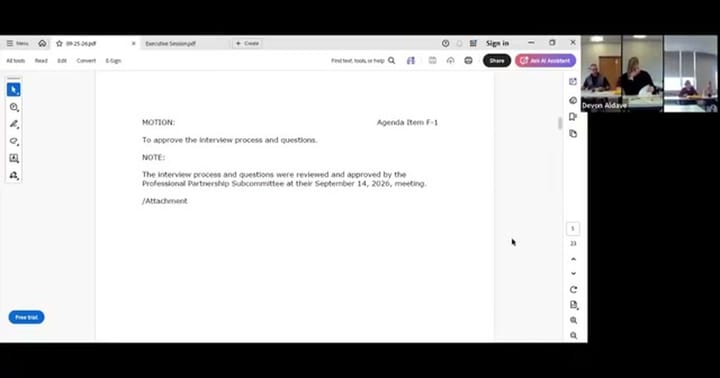
Farmington's Fire Station Building Committee shortlisted five architecture firms for October 6 interviews on a $35 million renovation project. The committee unanimously approved an amended interview process and a fee proposal form, both previously vetted by its professional partnership subcommittee, before voting to advance EDM Studio, Prior Architecture, Kaestle Boos Associates, Silver/Petrucelli & Associates, and Tecton Architects. Members split a combined question on project experience and change orders into two, saying the original was "pretty loaded." One member said the fee proposal form "really seems to protect the town's interest" by requiring firms to itemize every scope item.
The committee entered executive session under Connecticut General Statutes Section 1-210(b)(24) to review confidential RFQ responses before naming the finalists. The town is targeting a bond referendum in spring or fall 2027.
In the full story:
- Who Was There
- Organizations And Documents Referenced
- The complete report — 1,822 words
Source: the Other Committee meeting of September 25, 2026, reported from the official video recording and transcript.
Checked against the record: before publication this article was automatically compared with the meeting transcript. It was corrected where it differed.
The Full Article
Call to Order and Procedural Items
The Fire Station Building Committee opened its September 25 meeting with the Pledge of Allegiance, took no public comment, and approved its August 19, 2026 minutes without discussion. No correspondence had been received. These items consumed only a few minutes before the committee turned to its substantive agenda: finalizing the interview process for architectural firms, approving a fee proposal form, and reviewing responses to its request for qualifications (RFQ) in executive session.
Interview Process and Fee Proposal Questions
Background and stakes: The committee is working from an agreed statement of needs and a $35 million project budget to renovate or rebuild fire stations in Farmington, including East Farms and Farmington Fire, with construction of additional apparatus bays. Before this meeting, the committee's professional partnership subcommittee had already reviewed and edited a draft interview process and nine candidate questions.
The question before the body: Whether to formally adopt the interview format and the specific questions each shortlisted firm will answer.
Substantive content: Under the adopted process, each shortlisted firm will deliver a 30-minute presentation and face 15 minutes of question-and-answer from the committee. Interviews will be scheduled roughly 50 minutes to an hour apart, with firms checking in separately through the receptionist so competing firms cannot observe one another's presentations. The nine questions, as amended, ask firms to: describe their understanding of Farmington's needs and existing station issues; describe experience on new-build and renovation fire station projects in Connecticut, specifically involving volunteer companies and historic districts; describe change-order history and budget-to-bid variance on a recent project; describe firm capacity to meet a spring or fall 2027 referendum timeline; describe recommendations on phasing construction across the three stations; describe a cost-estimating approach to manage price escalation and supply-chain risk; describe plans for public engagement and marketing between now and a town council presentation; describe experience managing contractor-owner disagreements on cost, schedule, quality or scope; describe experience securing reimbursement options such as utility incentives, historic tax credits or public safety grants; and describe the firm's project closeout process.
The deliberation: The committee split what had originally been a single, broad question combining general project experience with a request for specific change-order and bid-versus-final-cost figures. A member argued the combined question was "pretty loaded" and suggested isolating the change-order and cost-variance portion so firms could first speak in general terms before addressing financial specifics. Another member agreed, noting that architects' subcontractor coordination on mechanical and electrical trades often drives change orders, and that the committee wants to learn whether a firm has "learned from your change order process last time" rather than repeating past mistakes. The committee also agreed to ask firms to draw their change-order example from a recently completed project rather than older work. A member separately flagged that question four, about construction planning, was really asking about phasing across the three stations, and the group agreed to add "slash phasing" to the question language for clarity. A member confirmed the nine questions will not be shared with firms in advance, though they could technically be found by reviewing the minutes of this meeting.
"We thought it was important to hear from the interviewees on what they've done in Connecticut, we'll still hear from them on other things as well, but Connecticut is really key."
[00:04:33] — committee member
Procedural steps and outcome: A first motion to approve the interview process and questions was made and seconded, then set aside pending the question edits described above. After the committee finished revising the questions, a member moved to approve the interview process and fee proposal questions "as amended." The motion was seconded and passed by voice vote with no recorded opposition.
Implications and what is next: Each committee member will be assigned one or more of the nine finalized questions to ask every interviewed firm, ensuring a consistent comparison across candidates when interviews begin October 6.
Fee Proposal Form
Background and stakes: The professional partnership subcommittee met the prior week to review and approve a fee proposal form that will structure how shortlisted firms price their work. The form is meant to produce comparable, "apples to apples" cost submissions.
The question before the body: Whether to adopt the fee proposal form that shortlisted firms will complete and submit in a sealed envelope at their interviews.
Substantive content: The form will not be opened until after all interviews conclude. It defines the scope of services firms must price for the pre-referendum phase, schematic design, including civil, landscape, site work, structural, mechanical, electrical, plumbing, HVAC, roofing, masonry, hazardous materials abatement, and information technology and security work. It requires firms to attend committee meetings, and potentially town council or public workshop meetings, at the committee's discretion, and to manage regulatory approvals, including coordination with the state given that one Farmington fire station sits on a state road. General conditions mirror the RFQ: firms must sign the town's contract without modification, and the town intends to continue with the selected architect after a successful referendum while reserving the right to rebid construction-phase work. Exhibit A of the form is the cost proposal itself, broken out by station for the pre-referendum schematic design and third-party cost estimate, plus a separate, non-binding breakdown of anticipated future-phase costs, design development, construction documents, bidding, furniture, fixtures and equipment, and construction administration, that would eventually be rolled into the project's $35 million bond rather than billed separately. Exhibits B and C restate the town's expectations and require firms to initial each scope item to confirm it is included in their price, intended to prevent later disputes over items such as furniture, fixtures and equipment.
The deliberation: A staff member referred to in the meeting only as "Cap" walked the committee through the form section by section. One member observed the specificity "works both ways," protecting firms by making clear exactly what services they are contracted to deliver, not only protecting the town.
"That's the fee proposal, it really seems to protect the town's interest."
[00:15:03] — committee member
A separate exchange addressed how much design detail the RFQ and fee documents should specify upfront. One member asked whether station descriptions needed to specify a second floor over a new apparatus bay. A staff member explained that design specifics, such as separating turnout-gear cleaning areas from apparatus parking, are intentionally left to "visioning sessions" between fire department staff and the selected architect rather than locked in before a firm is chosen.
"We need separation for our turnout gear, the cleaning of our turnout gear, versus where we park our apparatus, and we need this for it."
[00:17:13] — committee member
Procedural steps and outcome: A member moved to approve the fee proposal form; the motion passed by voice vote with no opposition.
Implications and what is next: The fee proposal form will go to the five shortlisted firms ahead of their October 6 interviews, where sealed cost submissions will be opened only after presentations conclude.
Executive Session and RFQ Review
Background and stakes: The committee's next step required reviewing confidential responses to its request for qualifications, submitted by firms competing for the architectural and engineering contract.
The question before the body: Whether to enter executive session to discuss RFQ responses, and which firms to shortlist for interviews based on that review.
Substantive content: The committee cited Connecticut General Statutes Sections 1-200 and 1-210(b)(24) as the legal basis for closing the session, which exempts RFQ responses and related records from public disclosure until a contract is executed or negotiations end. The motion specified that only voting and non-voting committee members could attend the session, and that approval required what the chair described during the motion as a qualified vote threshold under the statute.
The deliberation: No substantive discussion occurred outside the closed session; the transcript resumes only after the committee returned to open session.
Procedural steps and outcome: The committee voted unanimously by voice vote to enter executive session. After returning to open session, a member moved to shortlist five firms for interviews on October 6, 2026: EDM Studio, Prior Architecture, Kaestle Boos Associates (heard on the recording as "Castle Booze Associates"), Silver/Petrucelli & Associates (heard as "Silver Petrocelli and Associates"), and Tecton Architects (heard as "Techton Architect"). The motion was seconded and passed by voice vote with no recorded opposition.
Implications and what is next: The five firms will present 30-minute proposals and answer committee questions on October 6, 2026. The committee's selection from that interview round will move the project into schematic design and third-party cost estimating ahead of a planned bond referendum in spring or fall 2027.
Adjournment
The committee asked whether there was any other business; none was raised. The meeting adjourned by voice vote with no discussion.
WHO WAS THERE
Committee members and the presiding chair were not identified by name in the available transcript; no committee roster or agenda document was supplied for this meeting, so officer titles could not be confirmed from any source.
A staff member referred to in the recording only as "Cap" presented the fee proposal form in detail; no surname or title was given.
A person referred to only as "Brenda" was mentioned once in connection with a prior conversation about project scope items; no surname, role, or title was given.
No members of the public offered comment; no outside applicants, attorneys, or consultants appeared at this meeting.
ORGANIZATIONS AND DOCUMENTS REFERENCED
Professional Partnership Subcommittee (referred to in the meeting as the "professional partnership group" or "professional partnership committee") — an internal subcommittee of the Fire Station Building Committee that pre-reviewed and edited the interview process, candidate questions, and fee proposal form before the full committee's vote.
Request for Qualifications (RFQ) — the prior solicitation to which architectural and engineering firms responded; the committee reviewed firms' responses in executive session before voting to shortlist five firms.
Connecticut General Statutes Section 1-200 and Section 1-210(b)(24) — cited as the legal authority permitting the committee to discuss RFQ responses in executive session rather than in open session.
Fee Proposal Form (Exhibit A, B, C) — the document approved at this meeting that will govern how shortlisted firms submit sealed cost proposals, broken out by station and project phase, against the town's $35 million project budget.
Statement of Needs — a previously agreed document establishing the project's scope and budget, referenced as the basis for the committee's process.
Prior facilities study (referenced as an RFQ addendum) — an earlier study detailing station-specific wants and needs, cited as a resource the selected architect and fire department staff will use during design "visioning sessions."
EDM Studio, Prior Architecture, Kaestle Boos Associates, Silver/Petrucelli & Associates, and Tecton Architects — the five architectural firms shortlisted for October 6, 2026 interviews; spellings are based on likely ASR correction of audibly garbled firm names and should be verified against the written RFQ shortlist.
Share this story
Know someone in Farmington who follows town government? Share Townbrief Farmington: they can sign up free.