Green Efforts Panel Puts Off Composting Pilot Call
Farmington's Green Efforts Committee put off funding a pilot food-waste composting bin at the town library, choosing to wait for a townwide survey due in December.
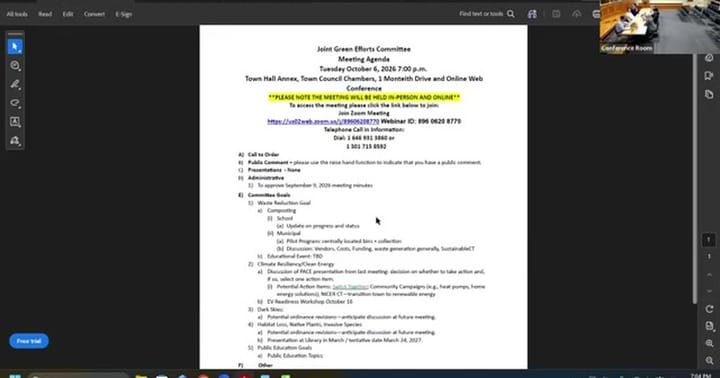
Other Committee · Meeting of October 6, 2026
Farmington's Green Efforts Committee put off funding a pilot food-waste composting bin at the town library, choosing to wait for a townwide survey due in December. Committee member Patty said she consulted town official Kathy Blonsky, whose "strongest recommendation is to wait for the survey" before spending from the panel's account. The green-efforts fund holds $38,657 but has gotten almost no new money since a $953 deposit in fiscal 2024, down from years that brought in $20,000 and $23,000 through now-dormant Solarize CT and Direct Energy partnerships.
A single-bin pilot was priced at roughly $4,000 to $6,000 a year, including MetroStore bin costs near $5,824 per unit and Blue Earth hauling quotes of $36 per pickup. Members separately approved their 2027 meeting schedule, except for November, and moved December's meeting to December 9 to avoid conflicting with the town's first survey-related community meeting, set for December 1.
In the full story:
- Who Was There
- Organizations And Documents Referenced
- The complete report — 2,949 words
Source: the Other Committee meeting of October 6, 2026, reported from the official video recording and transcript.
Checked against the record: before publication this article was automatically compared with the meeting transcript.
The Full Article
Minutes Approval
The committee opened by approving the minutes of its September 9 meeting after member Kimberly noted that a sentence under the presentations section had been cut off mid-thought. The correction was minor; the amended minutes passed with no opposition and no abstentions. This is a routine procedural step that consumed roughly a minute of the meeting.
School Food-Waste Composting Expansion
Background and stakes: The committee has an existing goal of reducing municipal waste through composting, and schools have been the easiest entry point because student-led programs helped the effort take root early at Irving Robbins Elementary and Union School.
The question before the body: whether to expand the schools' food-scrap composting program and how quickly that could happen.
Substantive content: Member Garrett relayed figures a school district staffer named Sam had compiled covering April through the end of the school year. Irving Robbins Elementary, which started the program April 24, collected 1,500 pounds of food scraps. Union School, also starting April 24, collected almost 1,900 pounds. Westwood Elementary, which started earlier on April 1 and therefore had an extra month of collection, gathered 4,700 pounds, the largest of the three. Combined, the three schools diverted roughly four tons of food waste from the trash stream in two months. One member speculated that an unusually high early pickup of 900 pounds the week of April 10 reflected pre-spring-break cafeteria cleanout, since the following pickup on April 29 was less than half that amount. Collected food scraps reportedly go to a food pantry.
Three of the district's seven elementary schools, Union Elementary, East Farms Elementary and Noah Wallace Elementary, still lack the program. District staff are working with hauler USA Recycling to price an expansion, but members said any rollout to those schools is more likely for the 2027-2028 school year because the district already signed a composting hauling contract for the current year. The high school is not currently part of any expansion plan; members said the district has deliberately started with younger students on the theory that habits formed early carry home and later into secondary school.
The deliberation included a lengthy aside on the town and school budget calendar: capital budget items move to the Town Council in February, the Board of Education approves its operating budget around the second Saturday in February, and the full town budget goes to a town meeting referendum in the spring. Members could not identify which specific budget line funds the schools' composting hauling, since it is folded into a single trash and recycling contract line rather than broken out separately.
Procedural steps and outcome: No vote was taken; this was an informational update.
Implications and what is next: Any expansion to the three remaining elementary schools will likely wait for the 2027-2028 school year, tied to the district's existing hauling contract and budget cycle.
Municipal Composting Pilot: Costs and Siting
Background and stakes: The committee has discussed a municipal food-waste composting pilot, using commercial collection bins in a public location, across multiple meetings. This session was meant to finalize cost figures and narrow siting options before any funding decision.
The question before the body: what a one- or two-bin pilot would cost, and where it could be sited given the town's limited non-floodplain, non-school land.
Substantive content: Members reviewed a cost breakdown for MetroStore FX-65 FP access-control cart enclosure units. The per-unit cost, including a flex option, was listed at $5,824; outfitting two units came to roughly $11,648, plus an annual data subscription of $38 per month per unit, or $912 a year for two units, bringing the combined estimate close to $12,000 for a two-bin build-out. An optional four-sided graphic wrap would add $1,145 per unit; omitting it and applying the town seal in-house would save roughly $2,000 across two bins. For hauling, Blue Earth's firm quote was $36 per pickup per bin, working out to $3,744 a year for two units or $1,872 for one; a second hauler offered an informal, non-firm quote around $25 per pickup, which members said they would want formalized before switching away from the company they already knew. Scaled to a single-bin pilot, members estimated roughly $6,000 for a full year including the wrap, or about $4,000 without it.
Siting discussion consumed significant time. Members worked through a floodplain map showing the 100-year floodplain and floodway along the Farmington River near Tunxis Mead Road and Meadow Road, concluding that the town's yard-waste drop-off site there sits just outside the mapped floodplain but that much of the surrounding parking is within a newer 500-year flood designation. Members ruled out several sites for lack of town ownership, parking conflicts with schools and fire stations, or private-property boundaries in Unionville Center, where multiple commercial parcels sit close together. The library emerged as the preferred first site because of its central location and steady traffic from library programs, tax collection and town meetings. Members discussed a possible second site near New Britain Avenue or the bike trail parking area but did not settle on one.
The deliberation: One member argued that proving volume at the library alone would not be enough to justify expanding beyond a pilot: "I think if you want to buy in to move a pilot into an actual program, I think you need to be able to demonstrate volume at multiple locations." Another member raised a practical question about whether removing heavy food waste from the regular trash stream would actually save the town money on hauling, since trucks are billed per trip rather than strictly by weight; haulers reported roughly 12.75 tons per trip, with per-trip costs rising from $76.92 in fiscal 2024-25 to $79.61 in the current year.
Procedural steps and outcome: No vote was taken on siting; the committee tentatively favors the library as a first location and will continue looking for a second.
Implications and what is next: A member assigned to follow up will confirm with the library whether the site is available and continue pricing a second location.
Green Efforts Budget and the Case for Waiting on the Survey
Background and stakes: The committee's discretionary account has shrunk to near-stagnant levels, raising the question of whether to spend down reserves on an unproven pilot or wait for data showing community demand.
The question before the body: whether to fund a composting pilot now from committee reserves, or wait for survey results expected in December.
Substantive content: The committee's green-efforts account held $38,657 as of the meeting, the product largely of historical one-time windfalls rather than ongoing revenue: $20,000 in one year and $23,000 in another, tied to now-dormant Solarize CT and Direct Energy partnership arrangements in which the town received a cut of residential enrollments. The account has received almost nothing since, with only a $953 deposit in fiscal year 2024 and no deposits since. Members discussed whether the fund could earn interest in a separate account, but concluded it is likely commingled with general town funds and that any interest earned would be negligible given current allocations. Separately, members discussed a state bottle-deposit ("nip bottle") fee statutorily restricted to litter-reduction equipment; the town is saving those funds toward a roughly $300,000 street sweeper and members concluded the fee could not be redirected to composting until after that purchase.
The deliberation: Member Patty reported on a conversation with town official Kathy Blonsky, who recommended waiting for survey results before spending. "I talked to Kathy as part of other discussions. Her strongest recommendation is to wait for the survey," Patty said. Patty relayed two specific risks Blonsky raised: that launching a pilot before gauging interest could leave the committee "with egg on your face" if it cannot sustain the program, and that strong survey interest in composting would make it easier to add funding to next year's town budget. Patty added her own concern: "I would not want to spend green efforts funds and find out that the community is really, really interested in something else that we could be spending money on to further green efforts." Other members pushed back on waiting entirely, with one arguing, "I just think food waste is one of the biggest problems in climate change. Every single town around us is doing something with food waste. We have almost $40,000 in the budget." A further complication: the ongoing townwide property revaluation is shifting tax burden toward residential properties, which members said will make this an unusually sensitive budget year at the Town Council level regardless of the survey's outcome.
The underlying survey is a 40-question instrument, 30 substantive questions plus 10 demographic questions, combining the town's Plan of Conservation and Development update with a separate Town Council strategic-plan survey that had originally been planned on its own. It goes live Friday, October 9, stays open four to six weeks, and results are expected in December; the committee likely will not see results until its January 2027 meeting. The survey will be available in English, Spanish, Mandarin and Tamil, per a Board of Education recommendation on the town's most common languages, and will be distributed through postcards, a QR code in the town newsletter, Everbridge alerts, and sign-up tables at weekend community events. A separate matching-grant program through Sustainable CT could fund part of the cost if the committee demonstrates community crowdfunding support, matching up to 20 percent of a project's cost if the committee itself contributes that share.
Procedural steps and outcome: No vote was taken. The consensus among members was to proceed with planning but hold off on final budget commitment until survey results are available, likely at the January 2027 meeting.
Implications and what is next: Any town budget support for composting would need to clear Town Council budget deliberations beginning around March 2027 for the following fiscal year; members said at least four council members want survey data before considering it.
Climate Resiliency and Clean Energy Follow-Up
Background and stakes: At a previous meeting, Mark Scully presented options the committee could pursue on clean energy, including group-buying solar partnerships and municipal clean-energy programs. Tuesday's session was a follow-up to narrow that list to a near-term action.
The question before the body: which, if any, clean-energy initiatives to prioritize before the next meeting.
Substantive content: Members reviewed town-level solar and electrification figures: 744 solar installations representing 11.4 megawatts of capacity, or roughly 4.4 percent of the town's electricity; 993 registered electric vehicles, about 3.9 percent of vehicles in town; 740 residential heat pump installations, 7.6 percent of residences; and 23 commercial heat pump installations, about 4 percent of commercial buildings. Members discussed reviving a group-buying solar partnership similar to past Solarize CT and Direct Energy arrangements, potentially through a platform called "switch together," and a separate municipal-level clean-energy program referenced in discussion (transcript rendering uncertain) that members said could affect municipal electricity purchasing rather than resident programs.
The deliberation: One member cautioned against taking on too much at once: "I think one. And then see how that goes. And then potentially a second." Another member raised questions about whether past Direct Energy revenue depended on residents purchasing versus leasing solar systems, noting broader market trends have shifted from roughly 80 percent purchased systems in the mid-2010s to roughly 70 percent leased systems today, which could affect whether a renewed partnership generates comparable revenue. On the question of whether the committee could commit the town to a vendor partnership on its own, one member stated the process requires a committee vote to recommend to the Town Council, which would then vote to opt in.
On electric vehicles, members noted the town's fleet is small: the water pollution control authority, planning and zoning, the building official, the public works director, the project manager, the fire marshal and three vehicles used by surveying, construction and engineering inspectors. Member Garrett is attending an EV readiness workshop October 16 and said he would report back information on long-term maintenance cost comparisons for electrifying the fleet, which members hope could inform a conversation with the town manager during upcoming budget preparation.
Procedural steps and outcome: No vote was taken; the committee agreed to continue the discussion at its November meeting and select a single near-term action item from the clean-energy list.
Implications and what is next: The committee will decide its clean-energy priority at the November 2 meeting; any fleet-electrification recommendation would need to be raised before the town manager finalizes fleet budget requests.
Public Education, Website, and Communications Strategy
Background and stakes: The town recently signed a contract with a new website vendor, triggered partly by a two-year-old state requirement that municipal sites use a .gov domain, giving the committee an opening to request dedicated space for sustainability education content.
The question before the body: what the committee wants from the new town website and how to sustain ongoing public education content such as newsletter articles and social media posts.
Substantive content: Members discussed requesting a dedicated webpage, potentially with a document-upload structure similar to the Planning and Zoning Commission's system for wetlands applications, to host recurring educational content on topics such as composting, recycling contamination and dark-sky lighting. Social media and newsletter postings must carry the "Farmington Green Efforts" brand, which only the Town Council can change, and must go through Town Hall channels; three people, including a staffer named Amanda and the IT office, control the committee's Facebook page to guard against unauthorized posts. Members also discussed reviving a past practice of rotating a "Green Idea of the Week" flyer, with one member noting a past newsletter article mistakenly caused confusion with the Highway Department over whether black plastic is recyclable, requiring direct outreach to correct the misunderstanding.
The deliberation: One member proposed the committee consider interns or volunteers to help generate content, asking whether government hiring rules complicate using interns; another member noted, "interns usually need a defined project timeframe" and that the town does not have vacant office space to support one, promising to ask a person named Carrie how a neighboring town structures its intern program.
Procedural steps and outcome: No vote was taken; the topic was deferred, with the website page request to be revisited once the new site structure takes shape, targeted for early 2027.
Implications and what is next: Any dedicated educational web content depends on the new website's rollout, expected around the start of 2027.
2027 Meeting Schedule and December Meeting Change
Background and stakes: The committee sets its meeting calendar roughly a year in advance and periodically must adjust around elections and holidays.
The question before the body: whether to approve the proposed 2027 meeting calendar, and whether to move the December 2026 meeting to avoid a scheduling conflict.
Substantive content: The committee confirmed it will meet as scheduled on Monday, November 2, 2026, despite the following day being a local election, reversing a past practice of canceling the November meeting in election years. For December 2026, members moved the meeting to Wednesday, December 9, to avoid overlapping with the town's first Plan of Conservation and Development community input session, scheduled for Tuesday, December 1, from 5 to 8 p.m. at the Senior Center as an open-house format.
Procedural steps and outcome: A motion to approve the 2027 meeting schedule as presented, except for the November date pending further review of a local-election conflict, was seconded and approved by unanimous voice vote.
Implications and what is next: The committee's next regular meeting is November 2, 2026; its December meeting moves to December 9, 2026.
Other Business: Land Trust Anniversary
A member announced the Farmington Land Trust's Memorial Forest is holding a 100th-anniversary celebration October 24, from 1 to 4 p.m., with a rain date of October 25, including a walk and talk; interested members were asked to sign up through the Land Trust's website. This was announced, not deliberated, and required no committee action.
WHO WAS THERE
Committee members present (roles not confirmed against a roster; participation inferred from deliberation): Garrett, member; Kimberly (also referred to as Kim), member; Patty, member; Christina, member; Stacy, member; Mary, member. Carrie and Bree were referenced in discussion; their attendance at this meeting could not be confirmed from the transcript.
Staff: A staffer identified only as Amanda was referenced as having Town Hall access to the committee's Facebook page; an unnamed speaker self-identified as the committee's staff liaison. No surname or formal title for either could be confirmed from the transcript.
Referenced but not present: Sam, a school district staffer coordinating the schools' composting hauling contract; Kathy Blonsky, a town official consulted by Patty regarding the survey and budget timing; Mark Scully, who presented clean-energy partnership options at the committee's prior meeting; Nancy Parent, a town staffer referenced in the fleet-vehicle discussion.
ORGANIZATIONS AND DOCUMENTS REFERENCED
USA Recycling — hauler being priced for expanding school food-scrap composting to additional elementary schools. Blue Earth — hauler that provided a firm per-pickup quote for the proposed municipal composting bins. MetroStore — manufacturer of the FX-65 FP cart enclosure units priced for the composting pilot. Sustainable CT — state matching-grant program discussed as a potential funding source for composting bins, contingent on community crowdfunding. Solarize CT and Direct Energy — past town partnerships that generated one-time revenue of $20,000 and $23,000 in separate years for the green-efforts account. "Switch together" — group-buying solar platform discussed as a possible renewed vendor partnership. Town of Farmington Plan of Conservation and Development survey — 40-question combined POCD/strategic-plan survey, going live October 9, results expected December 2026, cited throughout the composting-timing debate. Avon, Simsbury, West Hartford — neighboring towns referenced as comparisons for solar group-buying campaigns and municipal intern structures.
Share this story
Know someone in Farmington who follows town government? Share Townbrief Farmington: they can sign up free.