Panel revises draft Farmington survey questions
Farmington's Oversight Committee reworked draft community survey questions on housing, environment and town-center traffic.
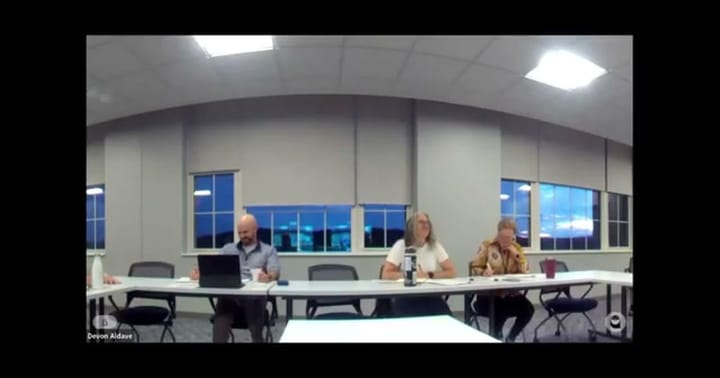
Other Committee · Meeting of September 21, 2026
Farmington's Oversight Committee reworked draft community survey questions on housing, environment and town-center traffic. The panel unanimously approved its September 4 minutes, then spent most of the meeting giving "tentative approvals" to survey language tied to the town's Plan of Conservation and Development update. Members replaced "workforce housing" with "entry-level housing," added an option for residents who "support restricting additional housing development," and dropped the term "pay to throw" from a waste-management question over concerns it could bias responses.
Resident Tim, of 62 Westview Terrace, urged questions on municipal debt and school efficiency, while Jay Toulin, of 39 Timberline Drive, pushed for an open-ended question on community programming, citing his Jewish Heritage event work with the Barney Library and Farmington Historical Society. A mapping question on neighborhood boundaries was tabled for further review. The committee's next session is September 30.
In the full story:
- Who Was There
- Organizations And Documents Referenced
- The complete report — 2,381 words
Source: the Other Committee meeting of September 21, 2026, reported from the official video recording and transcript.
Checked against the record: before publication this article was automatically compared with the meeting transcript.
The Full Article
Call to Order, Pledge and Public Comment
Background and stakes: The Oversight Committee's September 21 meeting opened with routine business but gave two residents a chance to shape the town's forthcoming community survey, a tool feeding into Farmington's Plan of Conservation and Development update.
The question before the body: whether to accept resident input on survey content before the committee's own line-by-line review.
A resident identified by the chair only as Tim, of 62 Westview Terrace, led the Pledge of Allegiance at the chair's request, then used public comment to hand committee members a list of suggested additions. He proposed questions asking whether a respondent or family member works for the town or schools or serves on a local board, whether the respondent is currently a student, how much municipal debt Farmington should carry, how much the town should spend on education, and where town schools could operate more efficiently. He stressed the survey should reach residents who are not already "in the middle of all this," contrasting casual respondents with committee members who already have inside knowledge of town operations. Tim asked the committee directly, "Madam Chair, does the Commission have any questions for me?" and received none.
Jay Toulin, of 39 Timberline Drive, spoke next, returning to a point he said he raised at a prior meeting: that the survey should include an open-ended question letting residents propose community programming. He cited his own work coordinating a Jewish Heritage event with the Barney Library and the Farmington Historical Society and connected the idea to the recreation portion of the strategic plan that guides the committee's work. "I do think that there is some value in some creative type of program, community program, educational program," Toulin said, adding he would "be listening to this very intently" going forward. A committee member, addressed by the chair as Keith, confirmed for the record that the night's agenda would focus on Plan of Conservation and Development questions and that recreation-related items, including Toulin's suggestion, would likely wait for a later meeting.
Outcome: No vote was taken on the public comments; staff indicated the open-ended programming idea and Tim's suggested questions would be considered as the survey is finalized in later sessions.
Approval of Minutes
This was a short procedural item. A member moved to approve the September 4, 2026 minutes, a second followed, and the committee approved them by unanimous voice vote with no discussion of changes.
Survey Overview and Logistics
Background: Before reviewing individual questions, the committee reviewed the survey's cover language, which addresses time expectations, the inability to pause and resume the survey, availability of paper copies, and pending translation language.
Members confirmed the survey will note it was prepared in coordination with the Farmington Town Council and the Farmington Planning and Zoning Commission. They also discussed where paper copies and pickup locations should be offered, agreeing the current plan, which includes the Barney Library on one side of town and the Senior Center on another, covers the municipal buildings reasonably well, while leaving open the option to add school-side locations. This section was given tentative approval without further changes.
Transportation and Mobility
The question before the body was whether the proposed matrix, "What transportation improvements do you want to see in Farmington?," adequately separated residential sidewalk gaps from larger connector gaps, such as along Farmington Avenue. Members agreed the draft already distinguished the two categories and discussed, but did not resolve, whether to add ranking; they concluded that a "select all that apply" format effectively creates its own ranking once response totals are tallied, since, as one member put it, "if 150 people choose sidewalks and only three choose roundabouts, you know where it sits on the list." The question was tentatively approved as written.
Economic Development
The draft question asked, "Is Farmington a good place to do business?" with a five-point scale. Members agreed with written comments from absent member Phil Cordero that the question needed to separate the perspective of business owners from that of residents who simply patronize local businesses, since "it's one thing to walk in and say I can do business in town" versus asking a business owner how operating here actually feels. The committee did not finalize new wording, instead directing staff to add demographic branching and bring back a revised version at a future meeting. This item was not given tentative approval.
Farmington Center and Unionville Center Character
Two nearly identical statements asking residents to agree or disagree with descriptions of Farmington Center and Unionville Center were discussed together. Members added language on traffic congestion and pedestrian safety to both, with particular attention to the Unionville trail crossing, which one member described as "a big crossing in the middle of traffic" rather than an ordinary sidewalk gap. The committee considered combining the two into a single rubric-style matrix, modeled on an example from New Canaan's Plan of Conservation and Development process, so respondents compare both centers side by side. Joanna, who appeared to be assisting with the SurveyMonkey platform, advised that combining five-point agreement scales for two locations in one matrix could become "unwieldy" without a dropdown option, which she said is not standard in the software. The group reached consensus to attempt the combined format with the added traffic and pedestrian-safety language, and tentatively approved both questions on that basis.
Housing and Affordability
Background and stakes: This section drew the longest debate of the meeting, reflecting ongoing uncertainty, reflected in Phil Cordero's written comments, over how residents interpret categories like "multifamily" and "affordable housing."
The question before the body was how to define housing-type categories so survey responses produce usable data. Members disagreed over whether "multifamily" should be synonymous with duplexes or with larger apartment buildings. "I find multifamily to be more synonymous with apartments than I do with duplex," one member said, while another countered, "In my mind, when somebody says multifamily, I'm picturing two families and three families." The group resolved the conflict by relabeling the duplex category as "duplexes," defined as two-, three- and four-family homes, and keeping a separate apartments category, which members renamed "rental apartments" to distinguish it from condominiums, an ownership type. Nursing homes and assisted-living facilities were consolidated into a single option after members agreed the distinctions used in some other communities did not apply clearly to Farmington.
On affordability, members debated whether "affordable housing" needed a parenthetical defining it as "income restricted," since, as one member said, "I would be shocked... if you poll ten people and you ask them what affordable housing is, they're not thinking first-time homebuyer." The committee added "entry-level housing" as a new, separate category intended to capture housing attainable for people moving to town without being explicitly income-restricted. "We can, instead of workforce, put entry-level there," one member said, a change another member credited directly: "Good call, Shannon." The full housing-type question was tentatively approved with these changes.
Housing Strategies
The draft question, "What housing strategies would you support?," originally listed only options implying additional construction. Members added a new choice allowing respondents to indicate they "support restricting additional housing development," after noting the absence of any option for residents opposed to growth. The committee also flagged, for future analysis rather than for the question itself, that residents who simultaneously select "restrict additional housing" and "reduce residential property tax burden" present a policy tension the committee will need to address in later workshops, since lower taxes generally depend on new development. One member noted the survey is explicitly designed to surface such conflicts: "I think you're going to have to peel the layers for all of this stuff." The question, with the restriction option added, was tentatively approved.
Natural Resources and Environment
The committee changed a question asking whether the town is "making significant progress" on protecting natural resources to instead ask, "Is the town doing enough to protect natural resources and environment?," after a member argued "progress implies there's already something in place." For a related question on environmental concerns, the committee adopted a "choose three" ranked format with randomized answer order, a feature Joanna confirmed SurveyMonkey can execute for each respondent, addressing a member's concern that environmentally engaged residents would otherwise "check every single one." A suggestion to add a question about where the town's trash is shipped was set aside in favor of addressing waste management in a later question.
Climate Resilience and Sustainability
Members revised the climate-concern question's example list, replacing "extreme heat events" with "severe storms/temperature" after discussion that the original wording might not register with respondents thinking broadly about climate change. A separate action-oriented climate question was expanded to blend heat and cold protection into a single option, "providing protection for extreme heat/cold," so the three-choice, randomized format would not force residents to split votes between closely related ideas. On sustainability, the committee lengthened the question's wording after initially favoring a shorter version, expanded respondents' selections from two to three, and removed the phrase "pay to throw" from a waste-reduction option, replacing it with "expansion or modification of waste management programs." One member explained the removal: "If people pick that D as their top three, they'd probably be more likely in favor of it once you explain what pay to throw is," arguing the raw term could prematurely turn off respondents.
Historic and Cultural Resources
The committee added "cultural and inclusion programs for youth and families" and a new line item for "the Farmington Riverfront" to a question about historic and cultural assets, following a member's point that public comment and prior council discussion had raised the riverfront specifically. The question was tentatively approved with those additions.
Future Development and Land Use
Members added "cemetery space" and "medical office buildings," distinct from general office buildings, to a question on where future development should be focused. The medical-office addition was tied to development activity near the UConn Health Center, which one member noted falls within a formally designated South Road health district in current planning documents. Members also flagged, for a later facilities-focused question rather than this one, ideas about expanding school buildings and distinguishing town-owned buildings from parks and recreational facilities. A member asked whether manufacturing land remains available in town; another replied there is little room left, a constraint the group did not resolve further.
Demographic Questions
This section consumed significant time on wording precision rather than substantive debate. The committee clarified that respondents who do not live in Farmington could still indicate they work, shop, visit, or attend school in town, cross-referenced against a zip-code question. Length-of-residency brackets were adjusted to two-to-four years and twenty-one-plus years to avoid overlap with adjacent categories. Household description language was changed to read "parent/guardian" throughout rather than "parent" alone, to capture households headed by grandparents or other caregivers. Employment categories were expanded to separately list retired, unemployed, current student, and a new "stay-at-home caregiver" option, replacing ambiguous phrasing that could have been read as describing a parent as unemployed. The education-attainment question was restructured to ask about current level of education and added a "current K-12 student" category.
The one demographic item not resolved was a proposed map asking respondents to identify their neighborhood. Members debated using the town's four school districts against a finer twelve-to-fifteen area breakdown drawn from the Plan of Conservation and Development, noting that some districts, such as East Farms, cover visually and demographically distinct sub-areas. Suggestions to instead use trash-pickup districts, a method one member said a neighboring town had used successfully, were discussed but not adopted. The committee agreed to review alternative maps with staff before the next meeting rather than finalize this question. Finally, members discussed a repeated question from a 2017-2018 town survey asking where residents get local information, collapsing newspaper and online categories into "local newspaper" with the Hartford Courant as an example, and separately listing "online news," while confirming the town's Everbridge alert system needs no fuller name on the survey.
Next Steps
The committee's next meeting is scheduled for September 30, 2026, when members will review a second batch of draft questions focused primarily on the town's strategic plan, plus items that overlap between the strategic plan and the Plan of Conservation and Development. Members indicated at least one additional meeting beyond that will likely be needed to assemble a final combined document, and agreed to use an online scheduling poll offering multiple day and time options for that session.
WHO WAS THERE
Committee members (roles not confirmed by any supplied roster or agenda): Keith, Shannon, Patty, Kathy, Robert, David, Peter — each participated in the question-by-question review.
Phil Cordero, committee member — absent; written comments on several questions were read into the discussion by other members.
An unnamed presiding chair, addressed only as "Madam Chair" during the meeting.
Staff/consultant: Joanna — described the SurveyMonkey platform's capabilities for formatting, randomization and page breaks; role/title not stated in the transcript.
Public commenters: Tim, 62 Westview Terrace — proposed additional survey questions on town employment, student status, municipal debt and education spending. Jay Toulin, 39 Timberline Drive — proposed an open-ended community-programming question, citing his collaboration with the Barney Library and the Farmington Historical Society.
ORGANIZATIONS AND DOCUMENTS REFERENCED
SurveyMonkey — the platform being used to build and administer the community survey; discussed repeatedly regarding question formatting, randomization and page display.
Barney Library — cited as a proposed survey pickup location and as Jay Toulin's partner organization for a Jewish Heritage event.
Farmington Senior Center — cited as a proposed survey pickup location.
Farmington Historical Society — partner organization cited by Jay Toulin in his public comment.
Farmington Town Council and Farmington Planning and Zoning Commission — named as co-sponsoring bodies to be acknowledged on the survey's cover page.
New Canaan Plan of Conservation and Development — cited as a reference example for a combined rubric-style survey question format.
UConn Health Center / South Road health district — cited in the future land-use discussion as the planning basis for separating medical office space from general office space.
September 4, 2026 Oversight Committee meeting minutes — approved by unanimous vote at this meeting.
2017-2018 Farmington community survey — cited as the source of the repeated "where do you get your information" demographic question.
Share this story
Know someone in Farmington who follows town government? Share Townbrief Farmington: they can sign up free.