Panel Reviews Minutes, Plans Church Walking Tour
Unionville Historic District and Properties Commission member announced plans to resign at year's end. The departing commissioner, addressed in the meeting as Lisa, said she and her husband, Ted, are relocating to Arizona, with the move expected by May or June of next year.
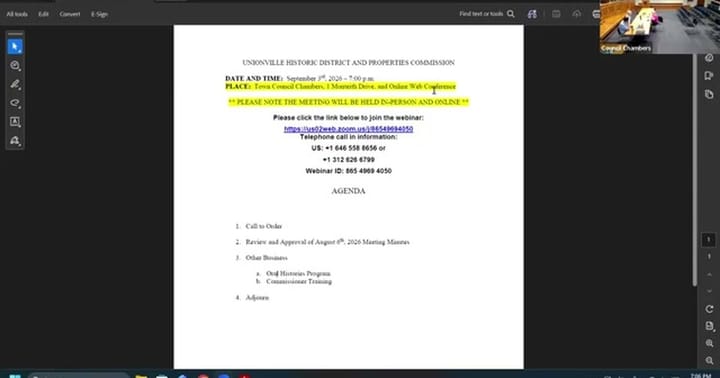
Other Committee · Meeting of September 3, 2026
FARMINGTON — Unionville Historic District and Properties Commission member announced plans to resign at year's end. The departing commissioner, addressed in the meeting as Lisa, said she and her husband, Ted, are relocating to Arizona, with the move expected by May or June of next year. Commissioners approved the August 6 meeting minutes with one abstention.
Member Ann disputed a state training video's claim on window energy loss, saying "you lose up to 30 percent of your energy through bad windows," not the 10 percent the video stated. Commissioners Barbara and Christine outlined early plans for a self-guided walking tour touching St. Mary's Catholic Church, the First Congregational Church, the gazebo and the Unionville firehouse, while member Matt reported the commission's digital tour platform, Pocket Sites, was acquired by another company, limiting new tours for now.
In the full story:
- Who Was There
- Organizations And Documents Referenced
- The complete report — 2,186 words
Source: the Other Committee meeting of September 3, 2026, reported from the official video recording and transcript.
Checked against the record: before publication this article was automatically compared with the meeting transcript. It was corrected where it differed.
The Full Article
Approval of August Minutes
The commission opened its September 3 meeting by taking up the minutes of its August 6 session, which it described as "a busy meeting" involving three certificate-of-appropriateness, or COA, applications. A member moved to approve the minutes, another seconded, and the chair asked for a voice vote. Three members said "aye"; one member said "I abstain." No discussion followed on the content of the minutes themselves. This was a routine procedural step consuming roughly one minute of the meeting.
Commissioner Training and Design Guidelines Review
Background and stakes: Connecticut historic district commissions are expected to keep members current on preservation standards, and the commission has been working through a state-provided training video module this year. The item exists on the agenda because not all members had finished the video, and the group wanted to flag concerns with its content before everyone completes it.
The question before the body: whether the training video accurately reflects the commission's own practice, and whether any follow-up action is needed.
Substantive content: A member identified as Christine said she had not finished the video. Another member, Ann, said she had watched it and found a specific factual claim incorrect. The video, presented in part by a state preservation official identified as Mary Dunn, stated that homeowners lose roughly 10 percent of heating energy through older windows and should generally rehabilitate rather than replace them. Ann disputed the figure: "You lose up to 30 percent of your energy through bad windows." Commissioners agreed the segment was "confusing" and said the commission's own guidelines, adopted in 2016 and amended June 2, 2022, already steer homeowners toward a middle path: install interior storm windows over existing historic sash rather than replacing them outright, a practice the group said is consistent with National Park Service standards. One member noted the Staples House already uses this approach. The guidelines also address window color matching, porch and step visibility from the property line, decorative retaining walls, and electric-vehicle charger placement, the last of which was added in the 2022 update along with EV-charger language.
The deliberation: Commissioners discussed how the commission handles judgment calls not spelled out in the guidelines, such as what to do if a tree damages a slate roof that would be prohibitively expensive to replace in kind. "I don't know what you would do in a case like that," Ann said, adding that homeowners still need to be able to live in and heat their houses. A member credited the commission's practical approach to staff member Garrett for scheduling COA reviews within state statutory deadlines when property owners have urgent needs, and for screening out applications where a material is being replaced like-for-like, such as asphalt-to-asphalt roofing, which the commission has decided does not require formal review. A member identified as Matt was credited by another commissioner with pushing the group to develop solar-panel standards several years ago after seeking to install panels on his own home; the commission said it is now well prepared to handle solar applications and has also evaluated newer composite materials as substitutes for historic building materials.
Procedural steps and outcome: No formal vote was taken on the training video or the guidelines. Commissioners agreed the printed guidelines are, or should be, posted on the town's Unionville Historic District web page, and one member said she would confirm and post them if they are not already there.
Implications and what is next: The exchange did not change any adopted standard, but it surfaces a live tension the commission regularly manages between historic-fabric preservation and modern energy and accessibility needs, an issue that will recur in individual COA applications going forward.
Walking Tour Planning: Churches, Gazebo and Landmarks
Background and stakes: Commissioners Barbara and Christine have been developing a self-guided walking tour of Unionville, an item that was on the agenda as a standing "other business" topic. The idea grew out of informal planning sessions, including one the two held sitting in the Unionville gazebo.
The question before the body: whether to endorse continued work on the tour concept, including outreach to local churches, and whether other commissioners want to contribute content or research.
Substantive content: Barbara described envisioning the gazebo, with its small community library, as a tour starting point, given the history of boarding homes in the area and nearby factory-owner residences on Main Street and Lovely Street. She proposed including tours of two or three churches: St. Mary's Catholic Church, the First Congregational Church, and the Old Stone Church, a former Methodist Church building that is marking its 100th anniversary this year, with a memorial service planned for November 15 at the original site before its congregation relocated to West Avon. Barbara noted masses for Unionville's early Catholic community were held in private homes before St. Mary's was built, an angle she and Ann said is worth researching through the Unionville museum and the churches' own records. Commissioners also discussed the history of the Masonic Hall building, now known as the Tryon-Sanford building, where the Methodist congregation briefly met before establishing its own building, with some overlap in timing. Christine said she had already compiled a candidate list of historic sites from her work on the Farmington Unionville Cultural District mapping committee and offered to circulate it to the commission for feedback. A rough walking route sketched during the meeting ran from the gazebo down School Street, up Main Street, through the St. Mary's parking lot, and back down Maple Street, covering roughly three-quarters of a mile, with the option for a self-guided, QR-code-based format that would let visitors stop at any point rather than walk the full loop.
The deliberation: Members weighed how much content to assemble before publishing anything. "I think that's the stuff that people, you know, that gets passed around, the cool stories," Christine said of finding specific anecdotes for each stop, tying the project to the commission's separate oral-history effort. Barbara said she would reach out to contacts at both St. Mary's and the First Congregational Church; one commissioner volunteered that her family built a house on Lovely Street for Daniel Johnson, described as an incorporator of the Congregational Church, and offered to provide a contact there. Commissioners also noted the Congregational Church still rings its bells nightly at 6 p.m., while members disagreed briefly, before correcting themselves, over whether St. Mary's also has bells.
Procedural steps and outcome: No vote was taken. Barbara said she would not assemble the full church-focused tour segment until early spring, pending outreach to both congregations, but would continue gathering general walking-tour content in the meantime.
Implications and what is next: The tour remains in early planning, with Barbara and Christine continuing outreach to the two churches and compiling a candidate list of stops for commission review before any public rollout.
Town Banner Project and Candidate Images
Background and stakes: A separate town project, described by one commissioner as involving "some budget," is selecting roughly a dozen images of Unionville and Farmington for decorative banners. The commissioner serving on that project brought the question to the historic commission because its members know the area's landmarks well.
The question before the body: which six Unionville images, out of roughly a dozen town-wide banner images, would best represent the village.
Substantive content: Commissioners quickly converged on several candidates: the Unionville firehouse at the end of Lovely Street, described as a longstanding symbol of both the commission and the village and already photographed for the project; the gazebo and adjacent bridge; and the new fishing pier, referred to as Polly's Pier, which one member said "gets the river in there" and reflects the commission's interest in representing newer community additions alongside historic ones.
The deliberation: No disagreement arose; members largely affirmed each suggestion as it came up.
Procedural steps and outcome: No vote was required or taken; the commissioner collecting images said she would keep the group's suggestions in mind for the final selection.
Implications and what is next: The banner selections are being finalized outside the commission's own process, with the commission serving only in an advisory, informal capacity.
Digital Walking-Tour Platform Transition
Background and stakes: The commission's existing self-guided walking tours are hosted on a mapping application, Pocket Sites, which a member reported has been acquired by another company.
The question before the body: whether the commission's existing tours remain accessible and whether new tours can still be built on the platform.
Substantive content: Matt said he believes the commission's existing walking tours remain live online, with four or five currently posted, but that the ability to create new tours is currently unavailable while he looks into the ownership change. He said he has also fielded a separate inquiry about a corporate or enterprise account tied to the platform.
The deliberation: Commissioners noted anecdotal evidence the tours are being used, including a sighting of visitors on Brook's Common pointing at landmarks with phones out.
Procedural steps and outcome: No vote was taken. Matt said he would continue investigating the platform change.
Implications and what is next: Any new church or landmark content developed for the tour cannot be published until the platform issue is resolved.
Commissioner Resignation Announcement
Background and stakes: Near the end of the meeting, under the standing "any other items" portion of the agenda, one commissioner raised a personal matter unrelated to the night's planning items.
The question before the body: there was no decision to make; the item was informational.
Substantive content: The commissioner, addressed later in the exchange by a colleague as Lisa, said she will resign from the commission at the end of December. She said she and her husband, Ted, are moving to Arizona to be near their youngest son, with the actual relocation expected in May or June of next year.
The deliberation: "I have a personal item I wish to just let you know about. But I will be resigning from this commission the end of December," she said. Colleagues expressed regret at the news; one member, Matt, was asked in a lighter aside not to mention a planned gift of cowboy boots to Ted before the move, which he agreed to keep quiet.
Procedural steps and outcome: No vote or replacement discussion occurred. The commission moved directly to a motion to close the meeting, which passed on a unanimous voice vote.
Implications and what is next: The commission will need to fill the departing member's seat by January, though no process for doing so was discussed at this meeting.
WHO WAS THERE
Barbara, member, present for the full meeting; active in the walking-tour project. Christine, member, present; active in the walking-tour project and the Farmington Unionville Cultural District mapping committee. Ann, member, present; raised the window-energy discrepancy in the training video. Matt, member, present; leads solar-panel and digital-platform matters for the commission. A commissioner addressed as Lisa, member, present; announced her resignation effective the end of December 2026. The presiding chair, role confirmed by the transcript (opened and closed the meeting, called for motions) but not named in the transcript. Garrett, staff, present; coordinates certificate-of-appropriateness scheduling; title not stated in the available sources. No roster, agenda or minutes document was supplied for this meeting, so attendance beyond the names spoken in the transcript could not be independently confirmed.
No members of the public spoke during the meeting; no public comment period occurred in the transcript.
Outside parties referenced but not present: Anne Fitzgerald, described as coordinating the Old Stone (Methodist) Church's 100th anniversary events; Patty and Tim, described as museum contacts for an upcoming fiber-art exhibit; Mary Dunn, a state preservation official featured in the training video.
ORGANIZATIONS AND DOCUMENTS REFERENCED
Unionville Historic District and Properties Commission design guidelines, adopted 2016, amended June 2, 2022 — cited throughout the training discussion as the governing standard for COA review, including window, porch, retaining-wall and EV-charger rules. National Park Service preservation standards — cited as the model underlying the commission's storm-window recommendation. St. Mary's Catholic Church — proposed walking-tour stop; one commissioner is a member. First Congregational Church, Unionville — proposed walking-tour stop; rings bells nightly at 6 p.m. Old Stone Church / former Methodist Church (relocated to West Avon) — marking its 100th anniversary with a November 15, 2026 memorial service, discussed as a walking-tour component. Masonic Hall / Tryon-Sanford building — referenced in discussing where the Methodist congregation briefly met before building its own church. Farmington Unionville Cultural District Committee — source of an existing landmark map Christine is drawing on for the walking tour. Unionville Museum — planned fall 2027 fiber-artist exhibit and "yarn bombing" installation around Unionville, discussed as complementary to the walking tour; also a potential research source for church history. Pocket Sites — the mapping platform hosting the commission's existing walking tours, reported to have been acquired by another company, limiting new-tour creation. August 6, 2026 commission minutes — approved with one abstention at this meeting. State-provided commissioner training video — reviewed in part by members this meeting; flagged for an inaccurate claim about window energy loss.
Share this story
Know someone in Farmington who follows town government? Share Townbrief Farmington: they can sign up free.