Farmington panel reviews draft community survey plan
Farmington's Oversight Committee opened review of a combined survey for the town's Plan of Conservation and Development and Strategic Plan update. Town Manager Kathy Blonsky said the panel's job is to "review and finalize the community survey questions" before an October launch.
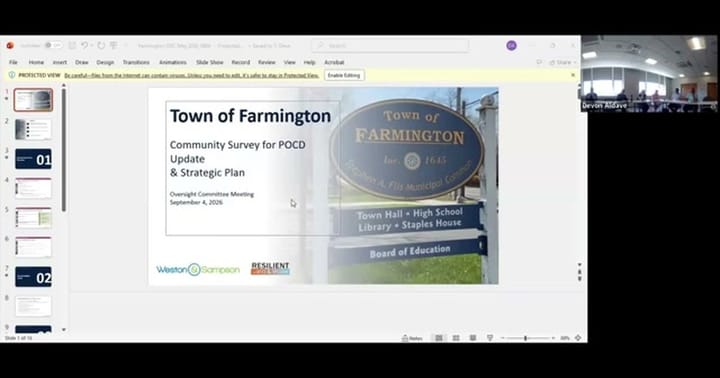
Other Committee · Meeting of September 4, 2026
Farmington's Oversight Committee opened review of a combined survey for the town's Plan of Conservation and Development and Strategic Plan update. Town Manager Kathy Blonsky said the panel's job is to "review and finalize the community survey questions" before an October launch. Weston Sampson project manager Robert Collins said the firm needs about 400 responses for statistical validity but expects more than 1,000, possibly 2,000, given a planned six-week outreach "sprint" that includes two mailed notices.
Town Council member Keith Goodrich pressed consultants on whether partial entries would count, asking, "Do somebody have to physically click submit... it doesn't count right?" Board of Education representative Erica Nolikowski raised concerns about reaching non-English-speaking families. No votes were taken; the committee scheduled work sessions for Sept. 21 and Sept. 30 to finalize the roughly 25-question survey.
In the full story:
- Who Was There
- Organizations And Documents Referenced
- The complete report — 2,266 words
Source: the Other Committee meeting of September 4, 2026, reported from the official video recording and transcript.
Checked against the record: before publication this article was automatically compared with the meeting transcript.
The Full Article
Committee Charge and Origins of the Joint Survey
The Oversight Committee held its organizational meeting on September 4, convened to review and finalize community survey questions that will serve both the town's Plan of Conservation and Development update and its Strategic Plan. Town Manager Kathy Blonsky described the charge as simple: the committee is not drafting the plans themselves but reviewing, finalizing and approving the survey instrument that will inform them, then stepping back once the survey launches. She told members the committee would meet three times in September to "hit the ground running," with this first session devoted to background and examples rather than specific question language.
Blonsky explained that the decision to merge two normally separate survey efforts, one for the Plan of Conservation and Development (POCD) and one for the town's strategic plan, came out of early conversations among herself, Shannon Rutherford and Town Council staff, who recognized overlapping subject matter. The committee will include members from Planning and Zoning, the Board of Education and the Town Council alongside the consulting team, something Blonsky said has not been done jointly in this way for prior surveys.
Statutory Timeline and Consultant Selection
Background and stakes: Connecticut General Statutes Section 8-23 requires the Planning and Zoning Commission to prepare and adopt an updated Plan of Conservation and Development before the current plan expires. Farmington's current plan, adopted in 2008 and amended with a 2018 addendum, expires in 2027, creating a statutory deadline for the town to complete a 2028-38 update.
The question before the body at this stage was not substantive but procedural: understand how the town arrived at combining the two survey efforts and who is doing the work. The town issued a request for proposals, interviewed two consulting firms, and selected Weston Sampson, represented at the meeting by project manager Robert Collins and consulting team member David Murphy. Blonsky noted this will be the town's third community-wide survey, after similar efforts roughly a decade and two decades earlier; a 2014 survey was referenced repeatedly as a stylistic and substantive benchmark for the new one.
The Three-Phase Survey Process
Collins and Murphy presented a three-phase framework. Phase one, running through the committee's three September meetings, covers drafting and finalizing survey questions; the September 4 meeting was explicitly informational, with a full draft survey promised for the September 21 work session and final confirmation of launch date and notification plans set for September 30. Phase two is the live survey period, which the consultants estimated would run roughly six weeks, from early October to mid-November. Phase three, in late November and into December, involves closing the survey, calculating the final statistically appropriate response rate, and preparing separate summary reports: one focused on the strategic plan for the Town Council, and one focused on the POCD for the Planning and Zoning Commission (TPZ in the transcript's usage). Each body will then hold its own work session with the consultants to review results, and the full raw SurveyMonkey data set will be attached to the summary reports and made public.
Collins said the survey will run on the SurveyMonkey platform with paper copies available for those who prefer them, later entered into the same system for analysis. He estimated the final instrument at approximately 20 to 25 substantive questions plus about 10 demographic "about you" questions, and said completion should take about 15 minutes. Asked directly what response threshold the firm needs, Collins said
"Um, but you usually want to be above like the 95 percent rate and based on the current town's population, that would be approximately 400 responses."
He added that with the town's planned notification push, including a newsletter mailing to every household, a second standalone postcard mailing with a QR code, email blasts, social media, flyers and community events, the town should comfortably exceed that threshold, potentially reaching 1,000 to 2,000 or more responses. No vote was taken on these parameters; they were presented as consultant recommendations for the committee to absorb before the September 21 session.
Survey Subject Areas
Substantive content: Collins walked through the subject categories the survey will cover, driven by what the state requires for a POCD and by brainstorming sessions with town staff and a Town Council work session held the Tuesday before this meeting. The categories are quality of life, municipal and educational services, community facilities and parks and recreation, transportation and mobility, economic development, housing and affordability, natural resources, resiliency and sustainability, historic and cultural resources, land use and development patterns, and community priorities and budgeting.
For each category, Collins described possible question formats drawn from three example surveys included in the committee's packet, from New Canaan, a project in New Shoreham, Rhode Island, and Woodbridge, plus Farmington's own 2014 survey. Examples included rating current quality of life on a one-to-ten scale and asking whether it has improved or declined over ten years; rating town services and facilities as excellent, adequate, needs improvement, or don't know; asking whether the town has enough of specific business types such as restaurants, daycare facilities or grocery stores; asking whether housing is accessible and affordable to seniors wanting to downsize or young families seeking starter homes; and asking residents to rank a set of ten to twelve community priorities, with SurveyMonkey's ranking tool allowing respondents to order choices from one to twelve. A budgeting section will ask residents to identify top priorities for town spending over an unspecified near-term horizon, which Collins said still needs fine-tuning, and will include a question gauging willingness to pay for expanded services. Erica Nolikowski, the committee's Board of Education representative, asked whether demographic questions would be available for review at the September 21 meeting; Collins confirmed they would.
Data Integrity and Submission Mechanics
The question before the body here was practical: how will the consulting team ensure survey results are accurate and not skewed by duplicate or incomplete entries? Town Council member Keith Goodrich pressed repeatedly on submission mechanics, asking whether a respondent must click a final submit button for an entry to count
"Do somebody have to physically click submit or if somebody fills out 85 percent of their intention of sending it in and just think it's done, it doesn't count right?"
Collins and Murphy said most partial entries are still logged once a respondent closes the browser, and that entries with fewer than roughly five answered questions are discarded because they provide no usable data. Entries are flagged for review, not automatically deleted, when a cluster of responses share both an IP address and identical answers across multiple questions; simply sharing a household IP address, as when multiple family members take the survey on the same computer, does not trigger exclusion because their individual answers will differ. Collins cited his experience on a New Canaan survey where roughly 400 responses arrived in a single day, initially raising concern about automated bot activity, which turned out to be the result of effective local notification rather than manipulation. No formal action was taken; the consultants indicated they would include clearer up-front instructions, such as advising respondents to set aside the full 15 minutes before starting, in the draft to be presented September 21.
Language Access for Non-English-Speaking Families
Background and stakes: Erica Nolikowski, representing the Board of Education, raised a concern that had surfaced in an earlier Town Council work session about how the survey would reach non-English-speaking households, noting the district serves a large Southeast Asian population among its English-language learners in addition to Spanish-speaking families.
"But how do we accommodate the populations of foreign, of non-English speaking families?"
[00:48:03] — Erica Nolikowski, Board of Education representative
Collins said Weston Sampson cannot build a multilingual version directly into SurveyMonkey but can produce translated paper or PDF versions, typically for the top three languages identified through census and school district enrollment data, once the town identifies which languages to prioritize. He described an internal quality-control process in which an initial AI-assisted translation is reviewed by in-house fluent speakers, covering more than 15 languages across the firm, before the translated version is finalized as a distributable PDF. Blonsky said she and Rutherford would reach out to the school superintendency, referred to in the meeting only as "Jess," and to the state for guidance on which languages to prioritize. No vote was taken; the item was left for town staff to research before the next meeting.
Demographics, Age Range, and Outreach to Students
The committee discussed whether the survey should be limited to a particular age group or household structure. Boye-Williams said the Town Council had already determined that the survey should be open to "anyone who wants to take the survey," regardless of age, provided they live in town. Nolikowski raised concern that some categories, particularly budgeting or housing questions, may be difficult for respondents under 18 to answer meaningfully, and suggested the survey allow more generous use of "I don't know" or skip options so that a young respondent's survey still counts toward the response total even if certain sections are left blank. Collins and Murphy confirmed that an entry with more than roughly five answered questions is retained even if later sections are skipped. They added that if youth response rates prove low once the survey is live, the team could propose a shorter, separate online version targeted at high school students or a more targeted outreach event, developed jointly with town staff at that point. No decision was made at this meeting beyond agreeing to monitor response patterns by age once the survey goes live.
Marketing and Community Outreach Plan
Blonsky outlined the town's planned notification channels: the town's Everbridge alert system, the town website and social media, existing email lists held by the recreation and economic development departments, Friday folders sent home through the schools, a town newsletter mailed to every household timed to coincide with other town notices, a second standalone postcard mailing carrying a QR code, press releases, and a calendar of "sprint" community events over the six-week survey window, including a firehouse pancake breakfast, a fall festival, a high school football game and regular appearances at local gathering spots. Blonsky said the plan includes the possibility of an iPad at events so residents can complete the roughly 15-minute survey on the spot. She asked committee members to recruit volunteers from their respective boards, Town Council, Planning and Zoning, and the Board of Education, to staff these events using a sign-up system she will coordinate. No vote was required; this was an operational briefing.
Procedural Steps and Outcome
The committee set its next two meetings: a work session on Monday, September 21, at 7 p.m., where members will review a full draft survey and focus on question formatting, response-option completeness and wording, and a final meeting on Wednesday, September 30, at 5 p.m., to confirm the survey and launch logistics. Boye-Williams asked that draft materials be distributed with the meeting agenda, typically issued the preceding Thursday, so members can prepare comments in advance rather than reviewing the survey cold. The meeting closed with a motion to adjourn, seconded, and approved by unanimous voice vote. No other formal votes occurred.
Implications and What Is Next
The committee's review at the September 21 and September 30 meetings will determine the final content of a survey expected to launch in early October and close by mid-November, feeding directly into both the town's legally required 2028-38 Plan of Conservation and Development and its Strategic Plan. Residents, including non-English speakers and students, will be able to weigh in once the survey goes live; the extent of translated materials and youth-specific outreach depends on decisions town staff and the committee have not yet finalized.
WHO WAS THERE
Patty Boye-Williams, Chair of the Oversight Committee, representing the Town Council. Keith Goodrich, Town Council member. Erica Nolikowski, Board of Education representative. Bill Cordero, Planning and Zoning Commission representative. Kathy Blonsky, Town Manager. Shannon Rutherford, identified in the roll call as Town Manager, with a correction offered during introductions identifying the title as Town Planner; title uncertain and flagged for verification. An unnamed staff member who identified themselves as Assistant Town Manager; name not captured clearly in the transcript. Robert Collins, Project Manager, Weston Sampson (consulting team). David Murphy, consulting team member, Weston Sampson. No members of the public attended in person or online, per the chair's roll call at the start of the meeting.
ORGANIZATIONS AND DOCUMENTS REFERENCED
Weston Sampson — the consulting firm selected through RFP to update the Plan of Conservation and Development and design the combined community survey. Connecticut General Statutes Section 8-23 — cited as the statutory basis requiring the Planning and Zoning Commission to adopt an updated Plan of Conservation and Development. Town of Farmington's 2008 Plan of Conservation and Development and 2018 Addendum — the current plan being updated; expires in 2027. SurveyMonkey — the online platform selected to host and analyze the community survey. 2014 community survey — Farmington's prior town-wide survey, used repeatedly as a stylistic and content benchmark for the new instrument. New Canaan, New Shoreham (Rhode Island), and Woodbridge survey examples — three sample surveys included in the committee packet and referenced throughout the presentation as formatting models. Farmington Town Council — held a work session the Tuesday before this meeting that generated feedback summarized in the committee's packet and referenced repeatedly regarding daycare, restaurants, sustainability programs and survey scope. Farmington school superintendency, referred to only as "Jess" — identified as a contact point for determining priority languages for translated survey materials.
Share this story
Know someone in Farmington who follows town government? Share Townbrief Farmington: they can sign up free.