Green Efforts Panel Defers Composting Bin Funding
Farmington's Green Efforts Committee weighed a $12,484 composting bin pilot but held off on funding it. PACE President Mark Scully told the panel the town spends $175 million a year on energy and emits 10.5 tons of carbon per resident, above the state's 8.5-ton average.
Other Committee · Meeting of September 9, 2026
Farmington's Green Efforts Committee weighed a $12,484 composting bin pilot but held off on funding it. PACE President Mark Scully told the panel the town spends $175 million a year on energy and emits 10.5 tons of carbon per resident, above the state's 8.5-ton average. A committee member pegged the all-in first-year cost of two "smart" composting containers at "$12,484," with Blue Earth Compost quoting $3,744 annually to empty them weekly.
Member Jen asked, "Are we spending money on this pilot program?" amid debate over whether the committee's roughly $30,000 account or the town budget should pay. Staff said Town Manager Kathy Blonsky begins department budget talks in January, pushing any funded start into next year's cycle. The committee approved its prior meeting's minutes unanimously but took no vote on composting.
In the full story:
- Who Was There
- Organizations And Documents Referenced
- The complete report — 2,577 words
Source: the Other Committee meeting of September 9, 2026, reported from the official video recording and transcript.
Checked against the record: before publication this article was automatically compared with the meeting transcript.
The Full Article
PACE Energy and Emissions Presentation
Background and stakes: The Green Efforts Committee invited Mark Scully, president of the nonprofit People's Action for Clean Energy (PACE), to walk the panel through a town-specific energy and emissions model PACE built using utility data, state building and vehicle registries, and its own analytical team of retired actuaries. The committee has no staff capacity of its own to produce this kind of data; the presentation was meant to give members a baseline before drafting any local clean-energy plan.
The question before the body: Members were asked to absorb PACE's findings on Farmington's current energy use, emissions and renewable-energy potential, and consider whether to start building a town clean-energy action plan.
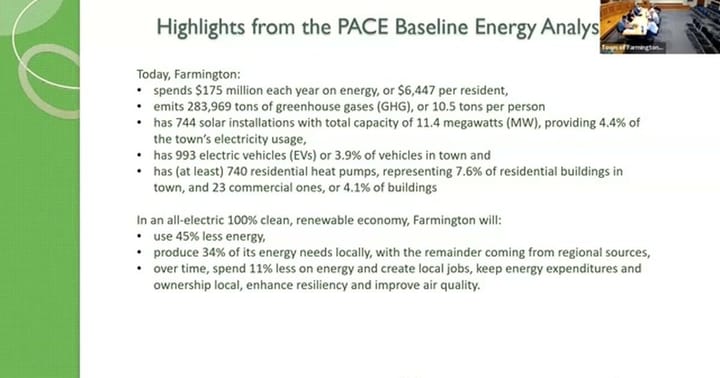
Substantive content: Scully said Farmington spends about $175 million a year on energy across residents, businesses, the municipality and schools combined, or roughly $6,447 per resident, broken into about $3,280 on electricity, $786 on gas and $667 on oil. The town's emissions total about 283,000 tons of carbon dioxide a year, or 10.5 tons per resident, compared with a statewide average of 8.5 tons. Connecticut's targets, set by the legislature in public act, call for per-capita emissions of 7.1 tons by 2030 and 4.5 tons by 2040, with a longer-run statewide goal of 2.6 tons by 2050 alongside a zero-emission electric grid. Scully's breakdown of today's emissions sources put 25 percent from the electric grid, 20 percent from natural gas, 17 percent from oil heat, and roughly 30 to 40 percent from transportation.
On renewables, PACE's data showed Farmington has 744 solar installations totaling 11 megawatts of capacity, covering about 4.4 percent of current electricity use; roughly 993 electric vehicles, just under 4 percent of the residential fleet; and 740 residential heat pumps plus 23 commercial units, about 7.6 percent of residential buildings. Scully said the model projects the town's overall energy use would fall by about 55 percent in a fully electrified, renewable-powered future, even as electricity consumption itself rises, because heat pumps and electric vehicles use energy far more efficiently than oil furnaces or gasoline engines. A separate PACE parking-lot analysis identified 137 Farmington lots with at least 100 spaces that could host solar canopies, with potential to generate up to 123 megawatts and cover roughly half of the town's current electricity usage.
"So you spend $175 million on energy... it's the municipality, it's the schools, it's residents, it's businesses, it's electricity, it's transportation, and it's building heating and cooling."
— Mark Scully, president, People's Action for Clean Energy
Scully also addressed nuclear power, batteries, data centers and offshore wind in response to member questions. "We don't have time, and it is the most expensive form of energy out there, right? The cheapest form of energy we have is solar right now, and it's getting cheaper," he said, adding that PACE's position is that "data centers should bring their own power" rather than straining the existing grid. On batteries, Scully noted Connecticut's current net-metering programs, NRES and RRES, expire at the end of 2027, with a pending Public Utilities Regulatory Authority docket, referred to in discussion as "PURE," expected to favor battery storage in whatever program replaces them. A member asked, "Is it better to wait to get a battery until 2027 or after 2027?" Scully said it likely depends on how the successor program is structured.
The deliberation: Members raised specific local concerns, including whether rooftop solar damages school roofs. One member relayed a conversation with Sam Kilpatrick, described in the meeting as the town's director of school facilities, saying "Sam said every single school that he's called with it has noticed a shortened lifespan" of membrane roofing under rooftop panels, as opposed to pitched asphalt-shingle roofs. Scully responded that PACE's research, including a 2023 report on solar at Connecticut schools posted on PACE's website, had not found that to be a widespread problem, noting West Hartford has installed solar on nearly every school roof. Another member asked about the town's own vehicle fleet and whether Farmington owns or contracts its vehicles; staff confirmed the town owns its fleet and buys one or two vehicles a year, with no electric vehicles currently in service. Scully invited the town to an October 16 event in New Haven centered on a national program called Charging Smart, aimed at helping towns reach "bronze" status in municipal EV readiness by next summer, including guidance on zoning, fleet charging and an EV showcase.
Procedural steps and outcome: This was a presentation item with no formal vote. Members thanked Scully and indicated interest in following up, including possibly inviting PACE's Peter Millman to discuss thermal energy networks and considering whether to send staff to the October 16 Charging Smart event.
Implications and what is next: The committee did not commit to any specific project, but members signaled interest in pursuing lower-cost, high-value actions PACE recommended, such as promoting the $40 Home Energy Solutions audit program and a "Heat Smart" campaign to raise awareness of heat pump rebates, both of which other towns have run with PACE's help.
Approval of Prior Minutes
Background and stakes: Routine business item required to formally close out the record of the committee's previous meeting.
The question before the body: Whether to approve the minutes as drafted.
Procedural steps and outcome: A member moved to approve the minutes; no changes were raised. The motion passed by unanimous voice vote.
Implications and what is next: No substantive implications; the committee moved directly into its goals discussion.
Composting Bin Pilot: Costs and Funding Questions
Background and stakes: The committee has been exploring public composting options since at least its prior meeting, when USA Waste representatives presented to the group. Photos of a West Hartford public composting container had circulated on social media, prompting renewed interest. The item exists on the agenda because the committee is trying to decide whether to recommend a town-funded pilot.
The question before the body: Whether to commit committee or town funds to a one-year, two-container composting pilot.
Substantive content: A committee member referred to in the discussion as Patty presented itemized vendor quotes from a bin supplier called Metro store. The base unit cost is $4,066 per bin; a custom graphic wrap costs $1,145; removing the standard foot-pedal lid costs an extra $315 if a buyer wants it removed (the committee opted to keep the pedal); and a monthly "smart" subscription enabling a resident-facing phone app and town dashboard costs $38 per bin. All-in hardware and wrap costs for two bins came to $11,572; adding the smart subscription ($38 x 2 bins x 12 months, or $912) brought the total first-year cost to $12,484, not including pickup service.
"So, if we bought two of them, it's $4,066 times two."
— Patty, committee member
On hauling, USA Waste's rough estimate was $25 per bin per emptying. Blue Earth Compost, the vendor the committee has used previously and said it wants to expand its relationship with the town, quoted $36 per pickup per bin, or $38 if the hauler also cleans the unit each visit; two bins picked up weekly for 52 weeks without cleaning would cost $3,744 a year.
The deliberation: Members debated whether the committee's own roughly $30,000 account, built up largely from small per-ton textile-recycling payments and discretionary spending that has included a $4,500 composting table for Union School and a one-time $4,000 townwide newsletter mailing, should cover the pilot, or whether the town budget should absorb it from the start. One member argued the committee should seed the town budget directly with the funds needed. Another said doing so immediately would risk the town declining to continue funding should the pilot not move forward, while a third worried about starting a program without assurance that ongoing hauling costs would be covered after the pilot year. Member Jen asked the group to consider the full financial picture, including money already directed toward composting at schools.
"Are we spending money helping the schools? Are we spending money on this pilot program?"
— Jen, committee member
Garrett, the assistant town planner, outlined the town's budget calendar: department-level discussions with Town Manager Kathy Blonsky typically begin in January, a capital budget request goes to the Town Council in February, and the operating budget follows in March. Members noted that would push any town-funded start of the pilot roughly a year out given an 8- to 12-week bin delivery window from the vendor.
Procedural steps and outcome: No motion was made. The committee agreed informally to gather additional cost and tonnage data and to have a conversation with the town manager's office and Public Works before deciding how to proceed.
Implications and what is next: Any decision on the composting pilot is now tied to the town's budget calendar. Members plan to raise the request with Town Manager Blonsky and Public Works ahead of the committee's next meeting, and to bring back updated tonnage and funding-source information.
Solid Waste Tonnage and Committee Finances
Background and stakes: Members wanted comparative cost data to make the case that composting could eventually reduce the town's garbage-hauling bill.
The question before the body: What does Farmington currently pay to haul solid waste, and could diverting food waste reduce that cost over time.
Substantive content: Staff reported that in 2025 the town's residential garbage hauling cost $115 per ton. In the most recently available full year, the town hauled 5,823 tons of residential solid waste, 1,613 tons of recycling, and 407 tons of bulk waste, with two bulk-waste pickup events during the year. Members noted these figures cover only households served by town garbage pickup, not private roads or multifamily buildings that contract separately. One member asked whether total tonnage has declined since Blue Earth Compost began serving individual residential customers, and staff agreed to check with the Highway Department.
The deliberation: A member cautioned that any savings argument "would take time" to materialize and that near-term costs could actually rise if a public pilot increases participation and pickup frequency before tipping fees fall.
"How long have we had $30,000 in there?"
— committee member, during the discussion of the committee's bank account
Members also discussed smaller revenue streams that feed the committee's account, including payments for textile recycling collected through the town's hauling contract, which one member said amount to "pennies on the dollar" but still offset the cost of never having to pay disposal tonnage fees for diverted textiles.
Procedural steps and outcome: No vote. Staff agreed to pull updated tonnage trends for a future meeting.
Implications and what is next: The tonnage and cost data will likely be used to support the committee's pitch to the town manager's office for ongoing composting pickup funding.
UConn Oak Seedlings and Other Brief Items
A member reported the University of Connecticut, referred to in discussion as "Yukon," is giving away free oak tree seedlings, descended from the historic Charter Oak, to towns that want them; the member is awaiting word by the end of the month on Farmington's interest. Another brief update covered a planned library program the committee is coordinating, tentatively set for March 24, pending the library's spring programming schedule. The committee also noted it will join a joint sustainability fair with the town of Simsbury rather than organize its own event this year, with planning meetings expected in December. No votes were taken on any of these items.
Social Media Promotion Policy for Local Businesses
Background and stakes: A member asked whether the committee could post on its Facebook page about a local business running a pollinator-friendly promotion, raising a broader question of whether the committee should amplify private businesses' sustainability efforts.
The question before the body: Should the committee adopt a practice of posting about businesses whose initiatives align with its mission.
The deliberation: Members raised concern that doing so for one business would create pressure to do so for any business claiming an environmental angle, and noted that town-affiliated promotion risks appearing to endorse private commercial activity. One member pointed out that businesses can post their own events directly on the town's Explore Farmington site without committee involvement.
Procedural steps and outcome: No vote or formal policy was adopted. The committee did not rule out individual case-by-case sharing but did not commit to posting the specific item raised.
Implications and what is next: The question remains unresolved; members left open the possibility of revisiting a broader social media policy.
WHO WAS THERE
Patty — presided over portions of the meeting including the vote on minutes and led the composting bin cost research; role within the committee not confirmed by any supplied source. Jen — committee member, questioned composting funding and school outreach. Mary — committee member, coordinating a library program and a joint sustainability fair with Simsbury. Bree (also heard as "Brie" in the transcript) — committee member. Kim Burley — committee member, gathered early information on the Metro store composting containers. Stacy — referenced once during discussion of solar installer contacts; attendance not confirmed. Garrett — town staff, assistant town planner, provided budget-calendar information and attends multiple town committees due to staffing levels. Sam Kilpatrick — director of school facilities; referenced but confirmed not on the call. Kathy Blonsky — town manager; referenced but not present. Mark Scully — president, People's Action for Clean Energy (PACE); guest presenter on the town energy and emissions model.
ORGANIZATIONS AND DOCUMENTS REFERENCED
People's Action for Clean Energy (PACE) — nonprofit that built and presented Farmington's energy-use and emissions model and discussed a potential town clean-energy plan. Energize CT — utility-funded efficiency program; cited for Farmington's Home Energy Solutions audit participation and heat-pump rebate data. Connecticut Department of Energy and Environmental Protection (DEEP) — cited regarding the renewable portfolio standard solar database, a pending solar-siting comment process, and school building data. Public Utilities Regulatory Authority, referred to in discussion as "PURE" — cited regarding the pending docket on successor net-metering programs after NRES/RRES expire in 2027. Eversource and United Illuminating (UI) — the state's two electric utilities, discussed in connection with net-metering credits, renewable procurement mandates, and EV-charger rebate programs. ISO New England — regional grid operator cited in explaining how Farmington's electricity supply is tied to a multistate system. Connecticut Green Bank — cited for the "Power Smart" residential battery incentive program and the forthcoming "Switch Together" bulk-purchase solar program. Solar United Neighbors — partner organization for the Switch Together program coming to Connecticut. Sustainable CT — state municipal certification program Farmington has joined by resolution; cited in connection with the Charging Smart EV-readiness event and its point system. USA Waste — Farmington's current municipal hauler and a contact for the schools' composting outreach. Blue Earth Compost — composting hauler under consideration for the residential pilot program. Metro store (bin vendor name as used in discussion) — quoted the committee for steel composting bin enclosures. Yale University — Professor Ken Gilliam cited as researching correlations between home solar adoption and EV ownership using town registration data. University of Connecticut, referred to as "Yukon" — offering free charter-oak descendant seedlings to towns. Town of West Hartford — cited repeatedly as a comparison town with an existing public composting program. Town of Simsbury — cited as a comparison and planning partner for solar, EV programs and a joint sustainability fair. Minutes of the prior Green Efforts Committee meeting — approved by unanimous voice vote at this meeting.
Share this story
Know someone in Farmington who follows town government? Share Townbrief Farmington: they can sign up free.